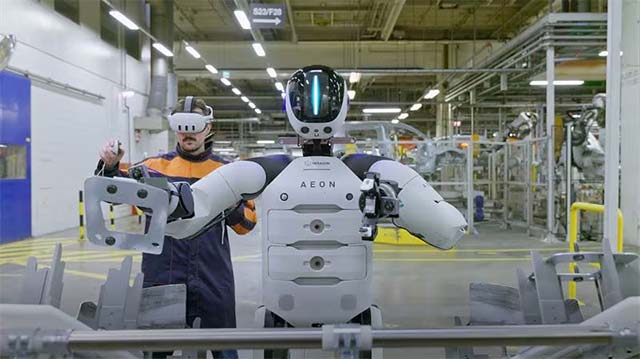
Volvo Cars is taking another step toward the future of automotive manufacturing by introducing humanoid robots at its factory in Ghent, Belgium. The Swedish automaker has started training AEON robots, developed by Hexagon Robotics, to perform industrial tasks alongside employees and existing factory automation.
The initiative aims to make manufacturing safer, more flexible and more efficient, while helping employees with repetitive and physically demanding work. Volvo plans to move from the current training phase to a factory pilot in 2027, with the goal of introducing the robots into real production from mid-year.
Ghent is the first Volvo Cars manufacturing plant to test humanoid robots, marking an important milestone in the company’s broader investment in advanced manufacturing technologies.
The first AEON robots are currently learning how to perform specific manufacturing tasks under the supervision of Volvo Cars employees and Hexagon Robotics specialists.
The training process uses a technique known as imitation learning. Instead of being programmed for every individual movement, the robots learn by observing and copying how human workers complete a task.
Their initial assignment involves picking up components and placing them into two fixtures with a high degree of precision.
Once the robots demonstrate consistent performance, Volvo plans to gradually introduce more complicated activities. These will include handling multiple components, moving around the factory floor and interacting with existing automated production systems.
The approach allows Volvo to evaluate how humanoid robots perform under real industrial conditions before expanding their responsibilities.
Automotive factories have relied on industrial robotic arms for decades. These systems are particularly effective at performing repetitive operations in fixed locations, such as welding, painting and component assembly.
However, not every manufacturing task can be handled efficiently by stationary automation.
Some operations require greater flexibility, particularly when components need to be handled in different positions or when employees must perform physically demanding movements throughout their shifts.
This is where humanoid robots could offer an advantage.
AEON’s human-like design allows it to operate in factory environments already built around human workers. Rather than requiring extensive changes to existing production facilities, the robot is designed to work alongside employees and established automation systems.
According to Magnus Nilsson, Chief Manufacturing Officer at Volvo Cars, the objective is to use humanoid robots for some of the most physically demanding tasks, helping improve workplace ergonomics while maintaining manufacturing efficiency.
Volvo’s approach is therefore focused on supporting factory employees and reducing physical strain rather than simply introducing another layer of automation.
The AEON humanoid robot has been developed by Hexagon Robotics, the robotics division of Swedish technology group Hexagon.
Standing 1.65 metres (5.4 feet) tall and weighing approximately 60 kilograms (132 pounds), AEON is designed as a versatile industrial robotics platform.
Unlike conventional humanoid robots that walk on two legs, AEON moves on wheels instead of feet. This configuration allows it to travel through industrial environments at speeds of up to 2.4 metres per second (8.6 km/h or 5.3 mph).
The robot can carry payloads of up to 10 kilograms (22 pounds) and uses an array of cameras and sensors to understand its surroundings and handle components with precision.
Its multi-purpose design is particularly important for automotive manufacturing. Rather than being limited to a single operation, AEON can be trained for different industrial applications as its capabilities develop.
This flexibility could make humanoid robots useful in production environments where conventional robotic arms cannot easily perform every task.
The current training programme is preparing the Ghent facility for a larger-scale factory pilot planned for the first half of 2027.
Volvo expects additional AEON units to arrive at the Belgian plant during this period, allowing the company to expand testing and introduce the robots to a wider range of manufacturing operations.
The automaker’s target is to begin using the humanoid robots in real production from mid-2027.
However, the transition will take place gradually, with performance and reliability evaluated as the robots move from controlled training exercises to more complex factory activities.
For Hexagon Robotics, the collaboration provides an opportunity to develop and validate AEON in a real automotive manufacturing environment.
Arnaud Robert, President of Hexagon Robotics, said the partnership is focused on ensuring that humanoid robots deliver practical business value by performing tasks that support existing manufacturing processes.
The post Volvo Trains AEON Humanoid Robots at Ghent Factory Ahead of 2027 Production Pilot appeared first on Electric Cars Report.