Porsche’s Cayenne Electric SUV, which will be launched in a few weeks, is based on a new version of the company’s Premium Platform Electric, and features a number of innovations, including a function-integrated battery, a dual cooling system, intelligent thermal management and an 800-volt architecture.
According to the combined WLTP standard, the new SUV will have a range of more than 600 kilometers. Several US journalists recently took near-production prototypes out for a highway range test and drove more than 350 miles (563 km) at a maximum permitted speed of 70 mph (113 km/h).
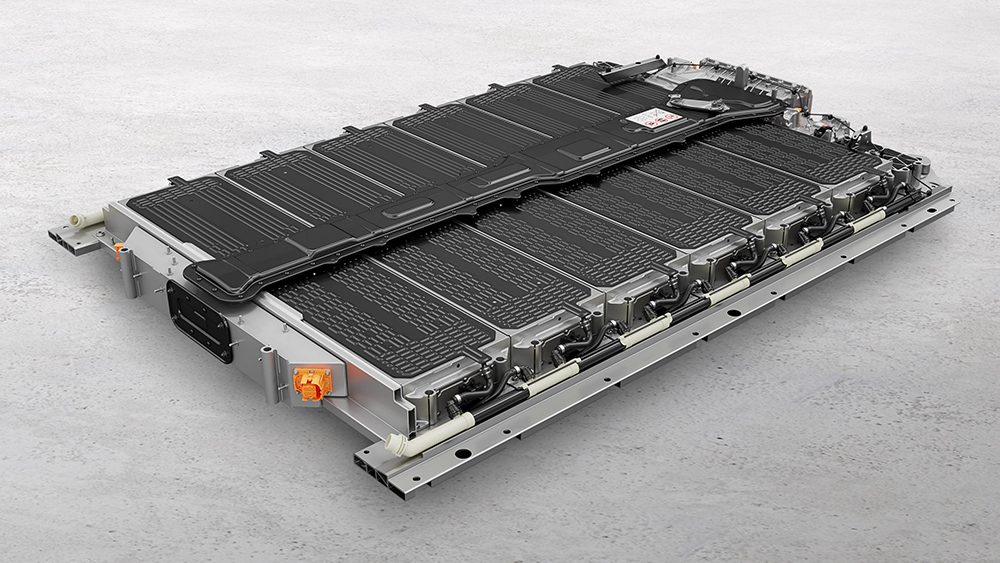
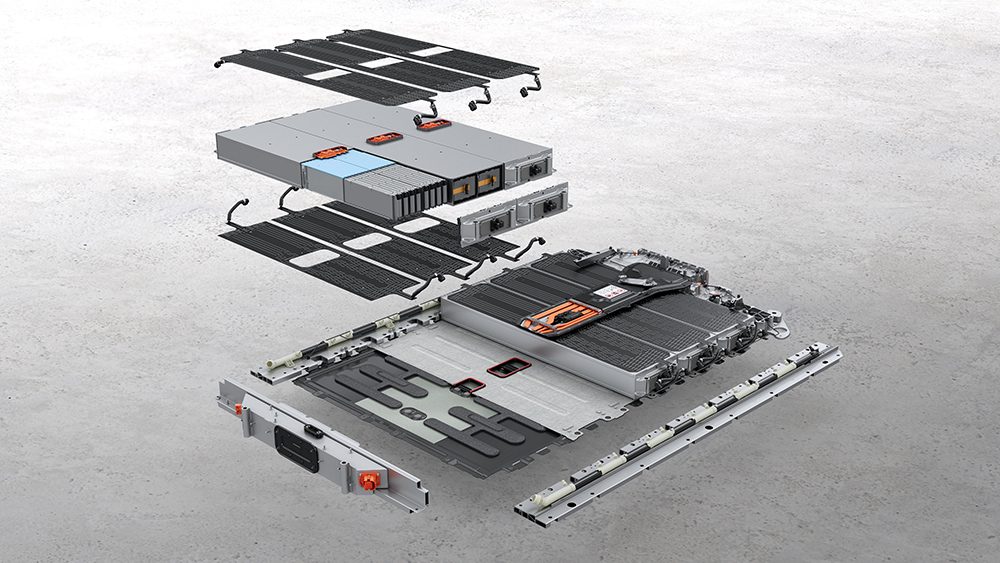
The Cayenne Electric’s battery pack has a gross energy content of 113 kWh. It is directly integrated into the vehicle structure, so in addition to storing energy, it acts as a structural component. Porsche explains that this yields significant advantages in weight and packaging—the ratio between cells and battery housing has improved by 12 percent compared to the second-generation Taycan battery. Integration of the battery into the body structure also increases vehicle rigidity and further lowers the car’s center of gravity. The battery modules use a specially developed aluminum profile that absorbs energy in a targeted manner and protects the cells in the event of an impact.
The battery pack consists of six interchangeable modules and 192 large-format pouch cells. Each cell includes a graphite-silicon anode and a nickel-manganese-cobalt-aluminum (NMCA) cathode. The high nickel content of 86 percent boosts energy density, and silicon in the anode enhances fast charging capability. Aluminum increases the rigidity of the cell structure. The result is seven percent higher energy density compared to the current Taycan battery, plus increased charging efficiency.
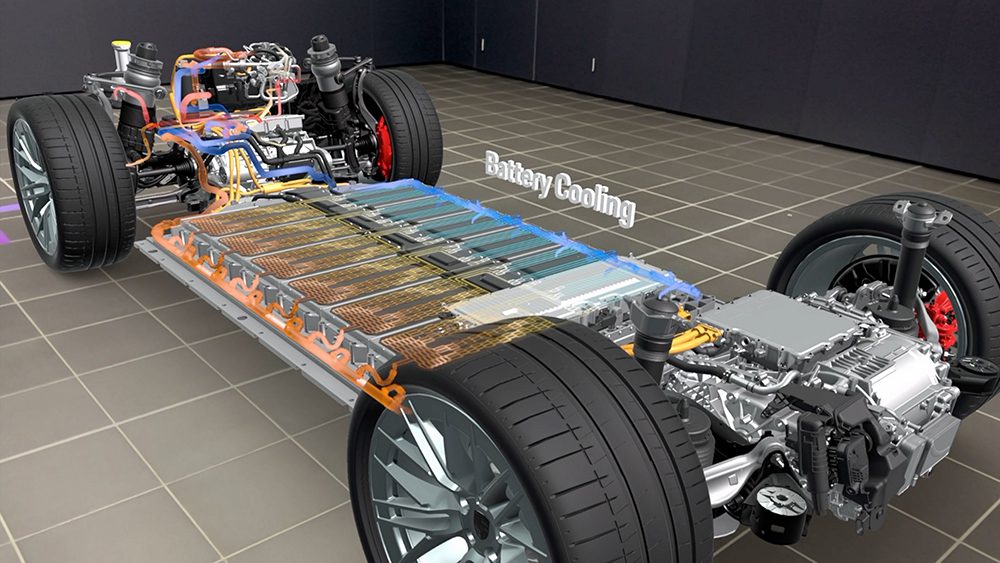
An innovative cooling system regulates the temperature of the battery from both above and below. This dual cooling allows precise control of the temperature window and ensures that the battery always operates in the optimal range. The system, which boasts cooling capacity equivalent to 100 large household refrigerators, features energy-efficient pressure fans, which consume around 15 percent less energy than conventional suction fans.
The new Predictive Thermal Management feature links all the vehicle’s cooling and heating circuits, continuously analyzes temperature, route and driving profile, and proactively controls the flow of energy. While driving, intelligent software calculates the heating or cooling requirements in real time. The aim is to keep the battery in the optimum temperature window at all times.
The Cayenne Electric can take up to 400 kW of charging power at suitable DC charging stations, and the company says it maintains this high level of charging power over an exceptionally wide state-of-charge band. Up to about 50 percent SoC, the charging rate consistently remains between 350 and 400 kW.
The 800-volt architecture combined with the high-voltage switch in the battery also enables efficient charging at 400-volt stations at up to 200 kW.
Starting in MY 2026, Porsche will offer the new Porsche Wireless Charging system—an 11 kW wireless charging system with a compact one-box floor plate.
“With the Cayenne Electric, we are taking e-performance to a new level,” said Dr. Michael Steiner, Deputy Chairman of the Porsche Executive Board. “Our innovative high-voltage system combines maximum efficiency with the driving dynamics typical of Porsche.”
Source: Porsche