Support CleanTechnica’s work through a Substack subscription, on Patreon, or on Stripe. Help us produce all of the high-quality, original content we publish week after week despite the challenges of content-scraping AI, antisocial media, inflation, and other hurdles.
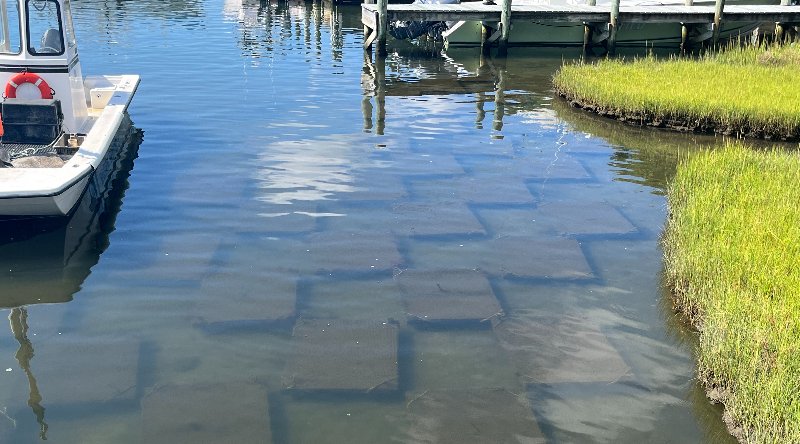
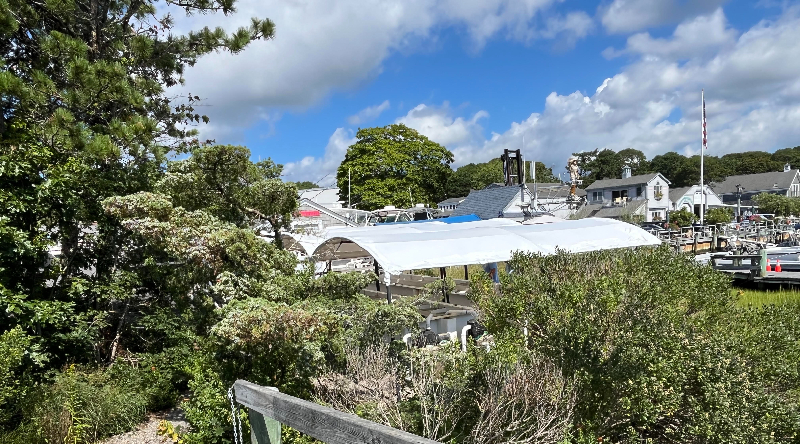
The walk down the slight incline to the East Falmouth harbor seemed a lot like many other waterfront areas of Cape Cod, Massachusetts. One and two story homes with weathered shingles. Pleasure craft and small commercial boats parked in gravel driveways. A combined aroma of seaweed and salt wafting on the warm breeze. But what caught me by surprise was the established aquaculture production on Waquoit Bay. I thought I knew that shellfish farms help to reduce pressure on overexploited wild stocks, yet I had no idea they were so ubiquitous on this upper Cape peninsula.
I was soon to learn a whole lot more about the rationale behind aquaculture.
On Cape Cod, towns are under regulatory, environmental, and legal pressure to implement strategies to restore water quality. Towns are exploring the use of less costly non-traditional management options such as shellfish aquaculture as part of their water quality management plans.
In 2018, a study undertaken by Roger Williams University described how Falmouth was developing a Rotational Aquaculture Plan that would allow limited private and municipal shellfish aquaculture in the town. The Plan was to expand aquaculture into estuaries to economically and environmentally benefit all users of the town’s estuaries and to assist in meeting the town’s water quality obligations. In fact, Falmouth was one of several municipalities in Massachusetts where municipal shellfish aquaculture was planned as part of a strategy to comply with the federal Clean Water Act.
And there was also an economic subtext. With Massachusetts shellfish aquaculture valued at $28 million and increasing, the demand for new farms was on the rise.
The Falmouth Select Board tasked the Water Quality Management Committee to explore non-traditional ways to remove nitrogen from the estuaries in the least expensive and most environmentally-sensible ways possible. Over the previous dozen or so years the Town had already researched many non-traditional alternatives to sewering.
The conclusions were that shellfish aquaculture is an alternative that has been quantitatively proven to work and has garnered community acceptance. In addition to nutrient removal benefits, the municipal aquaculture design could generate numerous positive economic benefits by creating jobs, expanding a marketable product, and providing a revenue stream for municipal propagation of municipal shellfish.
An online aquaculture siting tool called MA-ShellfAST, supported by the NOAA Sea Grant Aquaculture Extension and Technology Transfer program, was implemented that provides Massachusetts growers and agencies with a geographic information system (GIS). It presents relevant environmental, legal, and municipal data in layers in a map-based format. MA-ShellfAST became a go-to resource for those considering getting into the industry as well as those who regulate it.
MA-ShellfAST has worked to assist growers in understanding the regulatory requirements, potential conflicts, and biophysical characteristics of a given site before applying for approval for that site. It also enables them to draw a map of their proposed site to submit with their application.
Shellfish farms were soon scattered throughout several waterbodies, including three farms in Eel River, one in Seapit River, one on the ocean side of Nantucket Sound, and another in Megansett.
By 2025 Deputy Director R. Charles Martinsen III was telling the Falmouth Water Quality Management Committee that the potential acreage for the aquaculture was expanding, “more than quadrupling what we have now.” The local aquaculture program uses shellfish, primarily oysters, to extract nitrogen from water ecosystems and provide leasing opportunities for local shellfishers. It was expanding to anywhere from 80 to 140 acres. Farms were scaled up to produce 1.3 million oysters.
Revenue from the aquaculture sites far surpassed the town’s costs. Each farm pays the town back roughly $19,600 in leasing fees. Growers can also lease growing gear, such as shellfish bags and floats, from the town. Once the shellfish reach maturation, growers sell the mature shellfish to market. Revenue from the leases is placed in a revolving account that is used for purchasing shellfish seeds.
Water Quality Management Committee member Thomas Duncan gave a presentation on the costs-benefits and effectiveness of aquaculture compared to other methods of nitrogen removal, like innovative and advanced (I/A), denitrifying septic systems and/or urine-diverting systems. Duncan referenced data collected from 2021 to 2024 from Eel River. He said the shellfish there removed nitrogen equal to that produced from 26 single-family homes. He said it would cost roughly $2,088 to remove the same amount of nitrogen through urine diversion and roughly $1.17 million through innovative/alternative septic systems.
Of course, aquaculture alone will not solve the town’s nitrogen problems. Utilizing aquaculture as one of several tools, like sewer, denitrifying septic options, and urine diversion will collectively help the town meet its total maximum daily load requirements mandated by the State.
Waquoit Bay Pilot Projects
Waquoit Bay is located between the finger of Seapit Peninsula in East Falmouth, Cape Cod and the pine-shaded bluffs of Washburn Island. The Waquoit Bay National Estuarine Research Reserve contains open waters, salt and fresh marshes, barrier beaches, sand dunes, rivers, mixed pine and oak forests, and sandplain grasslands. Waquoit Bay is the dominant water feature and once supported one of the most diverse estuarine fish communities in the state. The area is still important to commercial and recreational shellfish and finfish fisheries.
Because Waquoit Bay and surrounding ecosystems are representative of shallow embayments in the northeast, the 2800 acres of land and water owned by the Reserve provides a dedicated, stable platform for scientific investigation. In fact, hundreds of studies over the Reserve’s thirty year life, as well long-term data from ongoing monitoring projects, make it one of the most studied estuaries in the northeast.
Oysters in the Reserve are part of the multi-farm collaboration project with Falmouth to aid with excess nitrogen in the area while also producing oysters which the farmers can sell.
For example, the Cape Cod Oyster Company situates its 22.8-acre oyster farm in an area the company says “is ideally suited for aquaculture.” Fed by nutrient-laden, fresh water from the Moonakis and Little Rivers and the salt water tides from Vineyard Sound, the Seapit River in high season creates just the right chemistry for growing succulent, hearty oysters. During the winter months, oysters reduce their feeding and respiration and are sensitive to handling, temperature stress, and ice cover. To avoid these off-season issues, oysters on Cape Cod are usually stored in deep water or land-based cold storage.
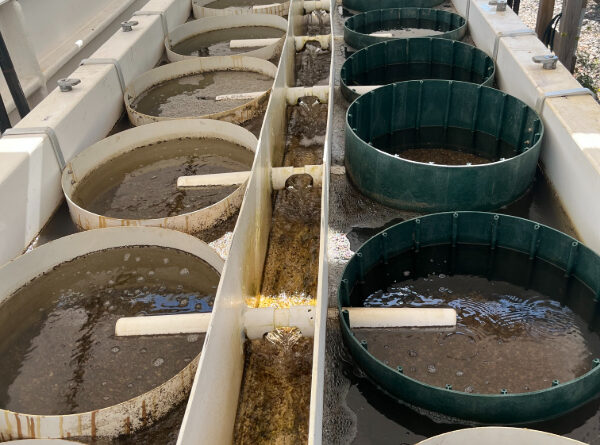
In 2020 Ward Aquafarms deployed their first round of oysters into the Eel River adjacent to Washburn Island in Waquoit Bay. Landbased upwellers are being used by Ward Aquafarms to grow seed during the nursery phase. Once the oysters are of a sufficient size to be moved into grow-out bags, they are transferred to the location on Eel Pond.
Oyster aquaculture is not a new concept. Cape Cod’s initial natural abundance of oysters was depleted in 1840, so shellfishers transplanted seeds from beds and harvested millions annually. The current resurgence began about 20 years ago with disease-resistant strains, specialized seed hatcheries, increased demand and prices, and new growing technologies.
Thanks to local resident, Jeanne Concannon, for introducing me to Falmouth’s vibrant aquaculture.

Resources
“Aquacultural production and nitrogen removal in Falmouth, MA: Current progress and projections.”
“Creating a spatially-defined tool for marine aquaculture siting and permitting: Case studies for pilot municipalities.” Kallie Longval and Read Porter. Marine Affairs Institute at Roger Williams University School of Law. January 2018.
“Delicious locally grown oysters – A benefit to the ecosystem.” Deborah Scanlon. oncapemagazine. May 28, 2024.
“Falmouth looks to quadruple aquaculture program.” Katie Nelson. Cape News. June 20, 2025.
“Setting ‘sites’ for aquaculture.” WHOI.
“Waquoit Bay Falmouth.” Cape Cod Oyster Company.
Waquoit Bay National Estuarine Research Reserve.
Sign up for CleanTechnica’s Weekly Substack for Zach and Scott’s in-depth analyses and high level summaries, sign up for our daily newsletter, and follow us on Google News!
Have a tip for CleanTechnica? Want to advertise? Want to suggest a guest for our CleanTech Talk podcast? Contact us here.
Sign up for our daily newsletter for 10–15 new cleantech stories a day. Or sign up for our weekly one on top stories of the week if daily is too frequent.


CleanTechnica uses affiliate links. See our policy here.
CleanTechnica’s Comment Policy