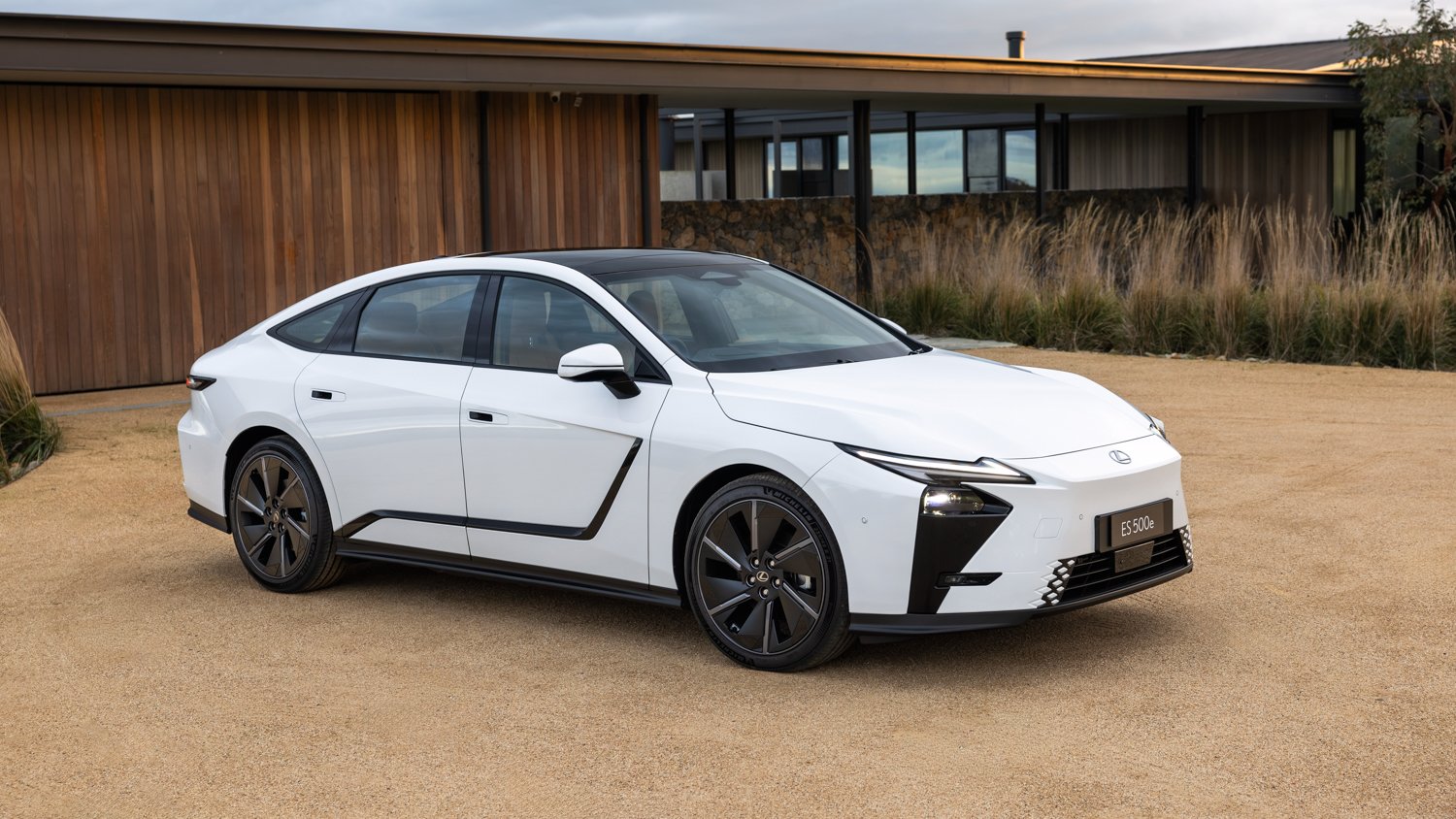
The Lexus ES has spent three decades being the sensible and reliable luxury sedan that also happens to nail the refinement piece.
Now it’s arrived without any noise at all. Well, almost none…
The eighth-generation ES has gone electric, and the dual-motor ES 500e is the most powerful version of the long-running luxury sedan Lexus has built.
Not sure this is the right EV for you?
It’s also the most adventurous-looking, which is not something that was previously top of mind with an ES.
READ MORE: Best luxury EVs in Australia 2026: Premium electric cars under $100k, $150k, $250k and beyond, priced and compared
READ MORE: First-ever electric Lexus ES detailed for Australia: Priced from $77,000 with 510km range
READ MORE: Lexus RZ450e review
Gone is the Camry-derived softness that defined ES models of old. In its place is a longer, wider, lower-slung fastback shape that packages either hybrid or pure electric drivetrain options.
Even the steering wheel has changed its mind about what Lexus is. The familiar ‘L’ badge has been replaced by the word LEXUS spelled out across the hub.
Small thing, but it’s indicative of a more exciting chapter for Lexus.
2026 Lexus ES 500e price and equipment
The electric ES range opens with the front-drive ES 350e Sports Luxury at $77,000 plus on-road costs, with 165kW and a claimed 510km of WLTP range.
The car tested here is the flagship ES 500e AWD Sports Luxury at $84,000 plus on-road costs, which adds a second motor on the rear axle for 252kW all up delivered to all four wheels.
A petrol-electric ES 300h hybrid joins the range later in the year from $75,000.

Both EVs share a 74.7kWh lithium-ion battery with 150kW DC charging and – unusually for the money – 22kW three-phase AC charging, which is genuinely useful if you’ve got three-phase at home or park near a decent AC charger.
Sports Luxury is the only grade, and it’s loaded accordingly: 21-inch alloys, semi-aniline leather-accented seats with 10-way driver adjustment and four-way lumbar, radiant leg heaters for both front occupants, three-stage seat heating, a heated steering wheel, panoramic roof with electric sunshade, rear door sunshades, doors that suck themselves closed, a head-up display, digital rear-view mirror, panoramic view monitor and a 17-speaker Mark Levinson sound system.
Screens run to a 14.0-inch central touchscreen and a 12.3-inch driver’s display, both running Lexus’ new Arene software with embedded navigation, wireless Apple CarPlay and Android Auto, over-the-air updates and an embedded drive recorder that uses the car’s own cameras for loop, manual and incident-triggered footage.

Adaptive dampers are standard on the EVs, as are nine airbags and an extensive safety suite.
The 500e also scores unique 21-inch wheels, AWD badging and Interactive Manual Drive, which simulates eight gears complete with synthetic noise and a fake tacho.
The ES 500e undercuts premium electric alternatives such as the BMW i4 eDrive35 ($88,900) and Mercedes-Benz CLA 350 4MATIC ($91,300), while offering a larger body and generous passenger space. The Tesla Model 3 Performance and MG IM5 Performance sit closer on price and deliver substantially stronger acceleration, while the BYD Seal offers a cheaper alternative.
2026 Lexus ES 500e: What we think
Lexus has clearly decided that it was time to be a tad more adventurous with the look — both inside and out.
To be fair, it was a relatively low bar, but the new ES has also come out swinging — ditching the beige for something that is decidedly more visually enticing.
The core of the brand is to some extent untouched.
The ES is still a beautifully built car, immaculately screwed together, with every touch point feeling like someone cared about it.

The leather on the steering wheel alone makes most rivals feel like they’re not trying hard enough.
The star turn is the door trim. Lexus overlays strips of bamboo with surface-emitting lighting, so what looks like striped timber by day glows in that same stripe pattern at night.
Better still, it doubles as a warning system. Indicate with a car sitting in your blind spot and the stripes flash red in the door trim beside you. It’s the sort of detail that justifies a luxury badge far more convincingly than another screen would.
And there are fewer screens here than you’d expect, or at least fewer visible controls.
The instrument cluster is a trapezoidal-ish shape with its cowling echoing the same form, and the centre stack looks close to barren – a volume dial, a roller wheel and the front and rear demisters, which stay permanently lit.
Raise a hand toward it and the rest appears: temperature controls for each side, the camera view and a few other functions fade into existence.

The steering wheel buttons behave the same way, sitting dark until your thumbs get close.
It’s a neat trick and it works, because underneath the hidden graphics are physical switches rather than capacitive panels, so you still get a proper click.
The driver’s display offers a stack of layouts – one big central dial, twin gauges in the traditional idiom (although the left one is a power gauge rather than a tacho), a dominant map with digital readouts, or screens devoted to the driver assist systems and energy use.
Drive modes run Normal, Eco, Sport, Range and Custom, the last of which can only be configured when you’re stationary.
Select Sport and the car explains that throttle and steering sharpen and the transmission shifts at higher RPM, which suggests at least one engineer may not have fully embraced the whole EV thing as there is only a single speed.
Paddles behind the wheel adjust regeneration across five settings, from full coasting through four increasing levels of retardation.
Less charming is the driver attention monitoring, which can get overly eager. Glance at the screen for a beat too long and it starts yelling (or chiming).
Storage is a mixed bag. There are two wireless phone chargers ahead of the centre console and a pair of cup holders, with a console lid that flips open from either side, but the pocket beneath the console is modest at best. Space is otherwise a strength.
The seating position is lower and sportier than the SUVs that dominate this money, which is refreshing in itself, and rear legroom is generous enough to make the back seat a properly luxurious place to sit.
The rear centre armrest is a thick, well-padded thing with its own storage and pop-out cup holders.
The boot is fine without being special at a claimed 517 litres, but the rear seats don’t fold – there’s only a ski port.

On the road the step forward is substantial. The old ES was a decent thing to waft about in but never much more than that; this one has genuine ability.
There’s ample thrust, with the 252kW combination good for a claimed 5.5 seconds to 100km/h.
More importantly, the steering, suspension and drivetrain all pull in the same enthusiastic direction.
Comfort is still clearly the priority, and the refinement is outstanding –- it is a superbly quiet car.
But lift the pace and it stays composed and competent rather than wallowing and asking you to stop.
Range is the one area where the ES 500e doesn’t especially impress.
The claim is 465km, well short of the front-drive 350e’s 510km — and a whole lot of mainstream EVs costing a lot less.
Yes, Lexus may have taken the EV plunge, but the brand is still off the pace when it comes to pushing the electric boundaries.

Efficiency is more impressive. Lexus quotes 17.9kWh/100km and our car was showing 16.1kWh/100km, which suggests the claimed range is achievable and possibly beatable in the right conditions.
The adaptive cruise control with lane centring also does a reasonable job, and the digital rear-view mirror can be flipped back to conventional glass if you want more traditional.
2026 Lexus ES 500e: Verdict
The ES 500e is the most interesting ES in a very long time, and comfortably the most convincing electric Lexus so far.
It nails the things Lexus has always been good at – build quality, refinement, materials, the small details – and pairs them with a chassis and powertrain that no longer feel like the afterthought in the equation.
Theoretically it brushes up against the quick end of the Tesla Model 3 and the BYD Seal on performance, but it’s clearly a more upmarket thing than either, and it feels it from the moment you shut the door.

The range number is the obvious caveat, a gentle reminder this car doesn’t get close to setting any EV benchmarks.
But for buyers who want a luxury sedan rather than another luxury SUV, and who care more about how a car is made than how far it goes, the ES 500e makes a quietly compelling case.
In fact, it’s the brand’s most compelling EV to date.
2026 Lexus ES 500e specifications
Price: $84,000 plus on-road costs
Basics: EV, 5 seats, 4 doors, sedan, AWD
Range: 465km (WLTP)
Battery capacity: 74.7kWh
Battery warranty: 10 years/unlimited km
Energy consumption: 17.9kWh/100km
Motors: 1 front 167kW/269Nm and 1 rear 88kW/170Nm, combined output 252kW
AC charging: 22kW, Type 2 plug
DC charging: 150kW, CCS2 plug (10-80 per cent in 28 minutes)
0-100km/h: 5.5 seconds