Maryland Governor Wes Moore signed companion bills SB649 and HB969 into law yesterday. The legislation, which becomes effective on July 1, 2026, is supposed to establish a uniform method of sale for electricity at public charging stations. Contained within the language of the bills is a provision that appears to directly conflict with how Tesla assesses congestion fees at busy Supercharger locations.
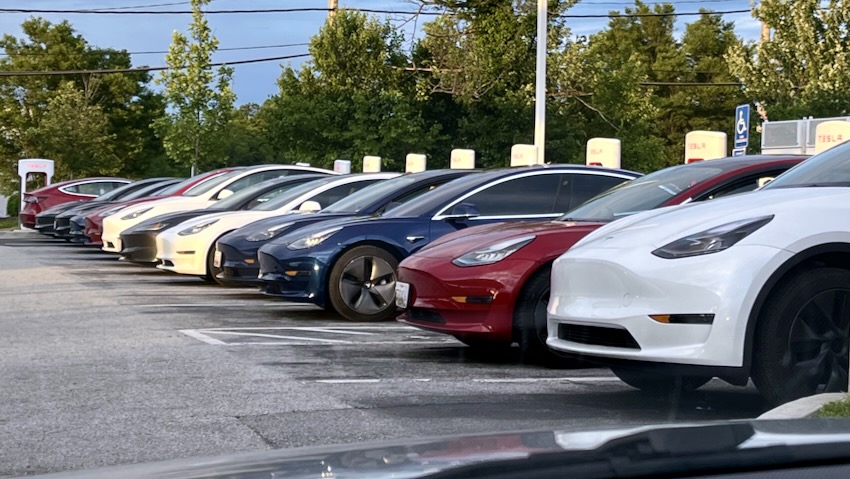
How Supercharger Congestion Fee Works
According to Tesla, congestion fees apply when a Supercharger site is busy and a vehicle’s battery reaches 80% state of charge. At that point, the driver is notified and a congestion fee, typically $0.50 per minute, begins accruing. If the driver unplugs within five minutes, the fee is waived.
Unlike idling fees, which usually begin once charging stops, Tesla’s congestion fees kick in while the vehicle is still drawing power. The idea is to encourage drivers to vacate the charging space when charging speed has dropped significantly, which happens at around 80%.
What the New Maryland Law Says
SB649/HB969 adds two method of sale rules to Maryland’s Weights and Measures statute.
The first governs what operators can charge during an active session. During a charging session, a customer may be charged only for the kilowatt-hours of electricity dispensed. Nothing else.
The second governs what operators can charge after a session ends. Additional fees, including time-based fees, are permitted, but only at the conclusion of a charging session, and they must be itemized on the customer’s receipt.
Tesla Testimony
On February 27, Tesla testified before the House Environment and Transportation Committee on the legislation. Tesla’s representative told the committee that the bill’s requirement that electricity be measured and sold in certain units had “undefined caveats” and asked legislators to at minimum clarify “that operators may assess fees to ensure that drivers can have access to charging and not have to wait excessively long times.” The Tesla representative also stated that “pricing is used as a signal to optimize access to charging, and make sure that folks leave once charging is complete.”
That generally describes the rationale behind congestion and idling fees, though it is worth noting that at the time, the amendments that would appear in the enacted version had not been added yet. Whether Tesla anticipated that the final bill would bar their specific implementation of congestion fees is not clear from the testimony.
What is clear is that Tesla was engaged in the Maryland legislative debate on these bills, made the case for operator flexibility on fees, and the legislature passed the legislation anyway with language that says time-based additional fees “may be applied only at the conclusion of a charging session.”
I also testified on February 27, though on slightly different grounds. My position was that unit-of-sale standards for EV charging belong at the national level and that any departure from the current NIST standards should be deliberated and adopted by the National Council on Weights and Measures rather than introduce a patchwork of carveouts enacted by state legislatures. The whole idea behind National Weights and Measures Standards is to have a uniform set of rules. With this legislation, Maryland has departed from the national standards on EVSEs.
The Conflict
SB649/HB969 says that during a charging session, a customer may be charged only for kilowatt-hours dispensed. Tesla’s congestion fee is not a kWh charge. It is a per-minute charge that begins at 80% SOC while the session is still active and energy delivery has not stopped.
The law also says that additional fees, including time-based fees, may be applied only at the conclusion of a charging session. Tesla’s congestion fee is triggered by an 80% SOC threshold rather than by the session ending.
On the plain language of the statute, Tesla’s current congestion fee structure does not appear to comply.
Tesla might argue that the fee is a charge for a service, specifically congestion management, rather than a charge for electricity. SB649/HB969 does allow fees for services related to the retail sale of electricity. But that provision also conditions any such fee on being applied only at the conclusion of a charging session.
What This Means for Maryland Supercharger Users
Tesla’s kWh energy pricing is unaffected. The company already bills energy delivery in kilowatt-hours, which is precisely what SB649/HB969 requires during an active session. Idle fees are also unaffected. A per-minute fee that begins after a vehicle is fully charged and energy delivery has stopped fits the new standard exactly.
The congestion fee, as currently structured, does not. For users of Maryland’s 640+ Supercharger ports, that means one of three things is likely to happen: Tesla restructures the congestion fee at Maryland Supercharger locations to trigger only after the session ends, Tesla stops assessing congestion fees at Maryland sites altogether, or Tesla waits to see whether MDA treats it as an enforceable violation.
The Bottom Line
The statutory language is not ambiguous on the core point. During a charging session in Maryland, the only lawful charge is for kilowatt-hours delivered. A per-minute fee that starts running at 80% SOC, while the vehicle is still charging, is not that.
Related
Discover more from Plug-In Sites
Subscribe to get the latest posts sent to your email.