A tax error first reported at one charging station turned out to involve more than 34,000 charging sessions across multiple locations. Refunds are promised, but it is unclear whether any have been paid.
Drivers using BGE’s public EV chargers were charged $11,987.43 in local energy taxes they did not owe, according to records BGE provided to Maryland Public Service Commission staff. The errors covered 34,118 charging sessions and ran until September 30, 2026.
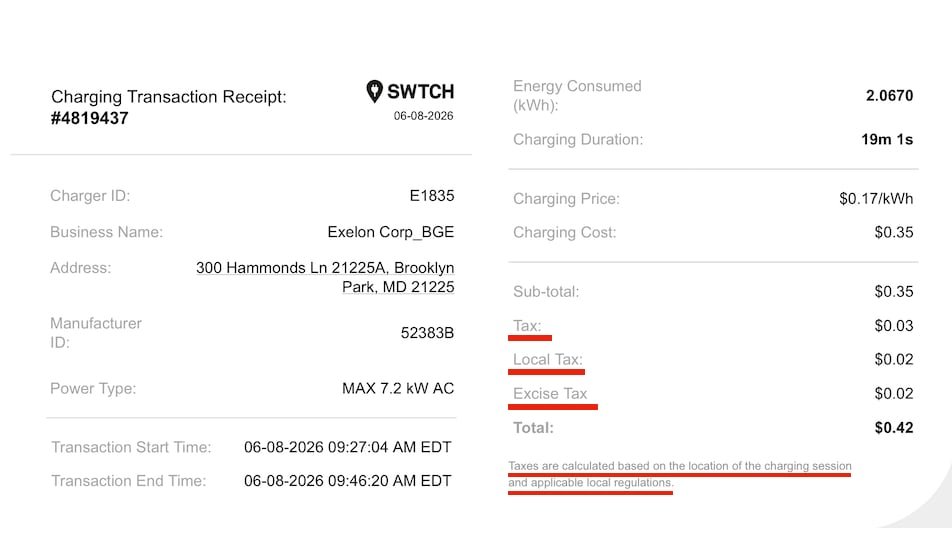
In August, BGE told Commission staff the problem was limited to one station in Brooklyn Park, where 47 sessions had been overcharged a total of $11.49. BGE also said an audit had found no other stations affected. Five weeks later, after staff produced a new receipt showing the tax was still being charged, BGE reported the much larger total.
I obtained BGE’s responses to four staff data requests through a Maryland Public Information Act request. The responses had not been posted to the Commission’s public docket in Case No. 9478, which covers utility-owned EV charging. They have now been filed there as attachments to my public comments (ML 336317).
What went wrong
BGE’s chargers run on a network operated by SWTCH, which handles payments and calculates taxes on each session. According to BGE, SWTCH assigned local tax rates by ZIP code, using a setup it put in place in 2024. That method fails where a ZIP code crosses a city or county line.
The result was two kinds of errors:
- Wrong jurisdiction. Five BGE stations outside Baltimore City charged the city’s energy tax. One was 300 Hammonds Lane in Brooklyn Park, in Anne Arundel County, whose 21225 ZIP code extends into the city.
- Charged twice. Some stations in Baltimore City charged the city energy tax two times on the same session. This was the larger problem, accounting for $8,435.69, or about 70% of the total.
BGE has not publicly identified the five stations outside the city or the city stations that double-charged.
| Improper local taxes at BGE chargers (through Sept. 30, 2026) | Sessions | Amount |
|---|---|---|
| Baltimore City tax charged outside the city (5 locations) | 11,083 | $3,551.74 |
| Baltimore City tax charged twice at city stations | 23,035 | $8,435.69 |
| Total | 34,118 | $11,987.43 |
| Eligible for SWTCH wallet credits | 31,370 | $10,845.03 |
| Not eligible for refund (guest and other sessions)* | 2,748 | $1,142.40 |
Small per session, large in aggregate
Most overcharges were small. The average was about 35 cents per session. But the error added a significant percentage to the per kWh cost.
Baltimore City’s energy tax is currently $0.011204 per kWh and was $0.010835 per kWh before July. On BGE’s Level 2 price of $0.17 per kWh, that comes to about 6.4% to 6.6%, which is more than Maryland’s 6% sales tax that is also applied to public EV charging station use. Each improper charge added that much to what drivers paid.
For comparison, the national accuracy standard for EV chargers, NIST Handbook 44, Section 3.40, requires AC chargers like BGE’s Level 2 units to measure energy within 1% accuracy when new and 2% in service. A charger that overstated energy by 6% would fail inspection. A tax error with the same effect on the price can apparently go unnoticed for months, and possibly since 2024, because drivers have no easy way to know which local taxes apply where they plug in.

How it came to light
I first raised unexplained “Local Tax” charges at utility-owned chargers with the Commission in February 2025. On June 8, 2026, I forwarded to the PSC a receipt from the Hammonds Lane station showing both a “Local Tax” and an “Excise Tax.” Commission staff then began asking BGE questions via official data requests.
On July 6, BGE agreed it had collected the Baltimore City tax in error at Hammonds Lane. The charges continued for almost three more months. In its October 1 response, BGE explained that SWTCH’s first fix worked only at the site level, while the older ZIP-code setup stayed active. SWTCH removed it on September 30, and BGE ran a test session that day to confirm the tax no longer appeared.
BGE’s October response was candid and corrected its earlier answers. But the full scope emerged only because staff kept asking, through four rounds of questions over four months.
Refunds: promised, but not yet visible
According to the responses, SWTCH told BGE that about 90% of the overcharges, $10,845.03, can be refunded as credits to SWTCH driver wallets. BGE said in August that customers should expect refunds within 45 days.
There are limits:
- Credits, not cash. Wallet credits only help drivers who keep using SWTCH chargers.
- Guest users are left out. Drivers who paid as guests, without a SWTCH account, cannot be refunded because SWTCH says it does not keep their payment information. That leaves about $1,142 with no path back to customers.
- No notice. None of BGE’s responses describes any notice to affected drivers.
I am a SWTCH account holder who was charged the improper tax at Hammonds Lane. As of November 12, I have received no notice or refund.
Questions BGE has not answered
- When did the overcharges start? BGE says the faulty setup dates from 2024, but its total gives no start date.
- What was the “Excise Tax” line on Hammonds Lane receipts, and is it included in the refunds? BGE’s August refund calculation covered only the Baltimore City rate.
- Which stations were affected?
- Have any refunds been issued, and how many drivers have received them?
- What happens to the money that cannot be refunded?
Not just a BGE issue
Every Maryland utility with public chargers relies on a network provider to set up local taxes. I have previously noted that two Potomac Edison stations in Montgomery County did not appear to charge the county energy tax, while Pepco stations in the same county did. Errors in either direction mean drivers are not paying what the law requires.
What drivers can do
- Check your receipts. Look for “Local Tax” or “Excise Tax” lines on charging receipts. At BGE stations, BGE says a local energy tax applies only in Baltimore City and Prince George’s County. Montgomery County also has an energy tax, which Pepco stations there charge. Two local tax lines on one session may indicate a duplicate charge.
- Check your SWTCH wallet for any credit, and contact SWTCH or BGE if you believe you were overcharged.
- Comment on the record. Members of the public can file comments with the Maryland PSC in Case No. 9478.
PlugInSites will report on any update BGE files with the Commission.
Sources
- BGE responses to Maryland PSC Staff Data Requests 1 through 4 and StaffDR3-1 Attachment 1, Case No. 9478 (June 17 to October 1, 2026), obtained by Maryland Public Information Act request and filed as attachments to ML 336317.
- NIST Office of Weights and Measures, Electric Vehicle Fueling FAQs.
Related
Discover more from Plug-In Sites
Subscribe to get the latest posts sent to your email.