The Tesla Effect — How the EV King Lost Its Crown
BYD Dethroning Tesla — A Seismic Market Shift
For over a decade, Tesla wasn’t just an EV company — it was the EV industry. Elon Musk’s Silicon Valley-born automaker had so thoroughly dominated the global electric vehicle narrative that “Tesla” and “electric car” were practically synonymous in the minds of mainstream consumers. That reality changed dramatically in 2025, and the story of how it happened is as instructive as any case study in modern business history.
In 2025, China’s automotive maker BYD became the world’s largest seller of electric vehicles, overtaking US EV pioneer Tesla for the first time — a shift that marks a major change in the global EV market. BYD’s pure battery electric vehicle deliveries rose by roughly 28% year on year, reaching more than 2.25 million units worldwide, while Tesla reported a decline of about 9–10% in overall vehicle deliveries versus the previous year. Carbon Credits
Globally, BYD claimed 12.1% of the BEV market in 2025, ahead of Tesla’s 8.8% and Volkswagen’s 5.2%, cementing this competitive shift. Carbon Credits
What makes this even more remarkable is the asymmetry of the competition. BYD isn’t available in the United States — arguably the world’s most brand-conscious automotive market. Tesla, meanwhile, sells strongly in China, which is BYD’s home turf. Despite these handicaps, BYD outpaced Tesla on pure BEV volume in 2025 by selling to the rest of the world — Europe, Latin America, Southeast Asia, the Middle East — at a pace that Western automakers simply cannot match on price.
BYD’s exports hit 1.05 million units in 2025, up 200% from the previous year, with Europe and Latin America as key growth drivers. Carbon Credits
Tesla’s Struggles — Brand Damage, Policy Shifts, and Fierce Competition
Tesla’s 2025 difficulties weren’t simply a story of being out-competed on price. The company faced a uniquely complex set of headwinds simultaneously.
Tesla’s vehicle deliveries fell 9% compared to 2024, the company’s net profit was down 46%, and CEO Elon Musk said it would put more of its focus on artificial intelligence and robotics. The Conversation
Musk’s high-profile involvement in US politics alienated a significant portion of Tesla’s core demographic — environmentally conscious, tech-savvy, progressive consumers who had been among the brand’s most loyal advocates. In Europe, Tesla showrooms became targets of protests. Rental companies publicly distanced themselves from the brand. The very identity politics that had made Musk a cultural icon became a liability for the vehicle company bearing his vision.
Meanwhile, the competition intensified from every direction. In China, rivals like Geely, China’s second-largest EV maker, fast-rising competitor Leapmotor, and latecomer Xiaomi — which debuted its first EV only in 2024 — gradually eroded BYD’s domestic market share, and by extension deepened the competitive pressure on the entire premium EV segment.
However — and this is important — the Tesla story isn’t over. In the first quarter of 2026, Tesla reclaimed the world’s top EV spot after its delivery numbers went up, delivering 358,023 EVs in the first three months of 2026 — a 6.5% increase over the same period last year — while BYD had a rough first quarter with 310,389 pure EVs reaching customers, a 25% decrease year over year. InsideEVs
The Tesla vs. BYD rivalry has become the defining competitive drama of the global EV era — a contest between American innovation culture and Chinese manufacturing scale, playing out in real time across every major market. Follow the latest EV brand competition developments as this rivalry continues to evolve quarter by quarter.
The Environmental Paradox — Is the EV Boom Really Green?
The Manufacturing Carbon Debt — Real but Temporary
Every major technology transition brings skeptics, and the EV boom is no exception. One of the most persistent questions surrounding electric vehicles is deceptively simple: are they actually better for the environment when you account for everything — manufacturing, battery production, electricity generation, end-of-life disposal?
The answer, backed by the most rigorous 2025 lifecycle analysis available, is a clear and well-documented yes. But the nuances matter enormously.
During the first two years of operation, electric vehicles produce 30% higher CO₂ emissions than gasoline vehicles when all lifecycle factors are considered, as the higher initial emissions stem from energy-intensive lithium mining and battery manufacturing processes. However, after the second year of on-road use, electric vehicles begin reducing cumulative emissions compared to gasoline alternatives. EurekAlert!
So the carbon debt is real — but it’s temporary, and it shrinks every year as battery manufacturing becomes more efficient, grid electricity gets cleaner, and recycling infrastructure matures.
Life-cycle emissions of battery electric cars are 73% lower than gasoline cars when using the EU average grid mix. When using only renewable electricity, the reduction rises to 78%. Life-cycle emissions of hybrids are 20% lower than gasoline cars. International Council on Clean Transportation
Those numbers deserve to be repeated loudly in every policy debate, media commentary, and dinner table argument about EVs. Per ICCT’s 2025 analysis, BEVs on the EU average grid produce around 63 g CO₂e/km over their full lifecycle, versus 235 g CO₂e/km for gasoline ICE vehicles. Devera
EV vs ICE Lifecycle Emissions Comparison (2025 data):
| Power Source | EV Lifecycle Emissions | ICE Equivalent | Reduction |
|---|---|---|---|
| EU Average Grid | 63 g CO₂e/km | 235 g CO₂e/km | 73% |
| 100% Renewable | 52 g CO₂e/km | 235 g CO₂e/km | 78% |
| Coal-Heavy Grid | Higher (still lower than ICE over life) | 235 g CO₂e/km | Variable |
The Grid Decarbonization Multiplier
Here’s the structural advantage that EV critics consistently underestimate: the emissions benefit of an EV improves automatically over time, simply because electricity grids get cleaner as more renewables are added. A petrol car registered in 2025 will produce the same carbon per kilometre in 2035. An EV registered in 2025 will produce significantly less carbon in 2035, because the electricity charging it will be substantially greener.
By 2025, renewable energy sources are expected to account for 56% of electricity generation in Europe — an 18-point increase compared to 2020. That shift in the grid mix directly improves the environmental performance of every single EV already on European roads, without any action required by the vehicle owner. International Council on Clean Transportation
By 2030, every additional kilowatt-hour of battery capacity is expected to prevent around 220 kilograms of CO₂ emissions, falling slightly to 127 kg by 2050 as the grid becomes cleaner and manufacturing efficiency improves. Innovation News Network
The environmental case for EVs is not static — it compounds over time. Understanding this dynamic is central to making sense of the electric vehicle environmental impact debate, which too often compares today’s EV against tomorrow’s ICE vehicle as if the grid never changes.
The US Policy Reversal — A Historic Missed Opportunity
Trump’s EV Rollback — What Actually Happened in 2025
If the global EV story of 2022–2024 was one of accelerating ambition, the United States in 2025 wrote a dramatically different chapter — one that future historians may well look back on as a defining industrial policy mistake.
On his first day back in office, President Trump signed the “Unleashing American Energy” executive order, directing agencies to pivot from prior clean-energy priorities and to reassess programs tied to EVs and charging. The order became the policy foundation for subsequent pauses and reversals that rippled across infrastructure, procurement, and standards. Battery Technology
The policy rollbacks that followed were sweeping in scope:
- Federal EV tax credits were terminated in September 2025, removing consumer purchase incentives that had driven mainstream EV adoption. Battery Technology
- The NEVI charging program froze approvals, delaying corridor fast-charging station deployment across states. Battery Technology
- Tariffs on EV components raised costs for manufacturers and slowed infrastructure development nationwide. Battery Technology
- California’s authority to set its own EV emissions standards was challenged at the federal level, throwing state-level ZEV mandates into legal uncertainty.
The impact was immediate and measurable. EV sales growth in the US was essentially flat in 2025, at about 1%, while global EV registrations rose 20% to 20.7 million. The Invading Sea
The Competitive Consequences — America at Risk of Falling Behind
The strategic implications of America’s EV policy reversal extend far beyond domestic sales numbers. They strike at the heart of industrial competitiveness in what is becoming the defining manufacturing sector of the 21st century.
In 39 countries, EVs now exceed 10% of new car sales, including in Vietnam, Thailand and Indonesia, which reached 38%, 21% and 15%, respectively in 2025. In the US, EVs accounted for less than 10% of new vehicle sales. The Conversation
The US share of global EV production declined from 7% in 2024 to 5% in 2025 as automakers pulled investments and delayed production — likely impacting their long-term competitive advantage. International Council on Clean Transportation
In 2025, China exported 2.65 million EVs, doubling its 2024 exports. The US risks becoming a follower in the industry it once defined. The Conversation
The verdict from industry analysts is blunt. As one leading automotive researcher noted: EV manufacturing is governed by steep learning curves and scale economies — meaning the more vehicles a company builds, the better and cheaper it gets at making them. Every year the US falls behind in volume, it falls further behind in capability. That’s not a gap you can close by simply turning policy back on in 2028 or 2029.
The United States risks being left behind as China, Europe, and emerging economies build their EV industries and capture global market share. American automakers and workers who need policy certainty and support to compete globally are instead navigating a landscape of rollbacks, tariffs, and regulatory uncertainty — precisely the wrong conditions for the long-horizon investments that EV manufacturing requires. Stay informed about US EV policy developments and their global ripple effects through ongoing coverage and analysis. International Council on Clean Transportation
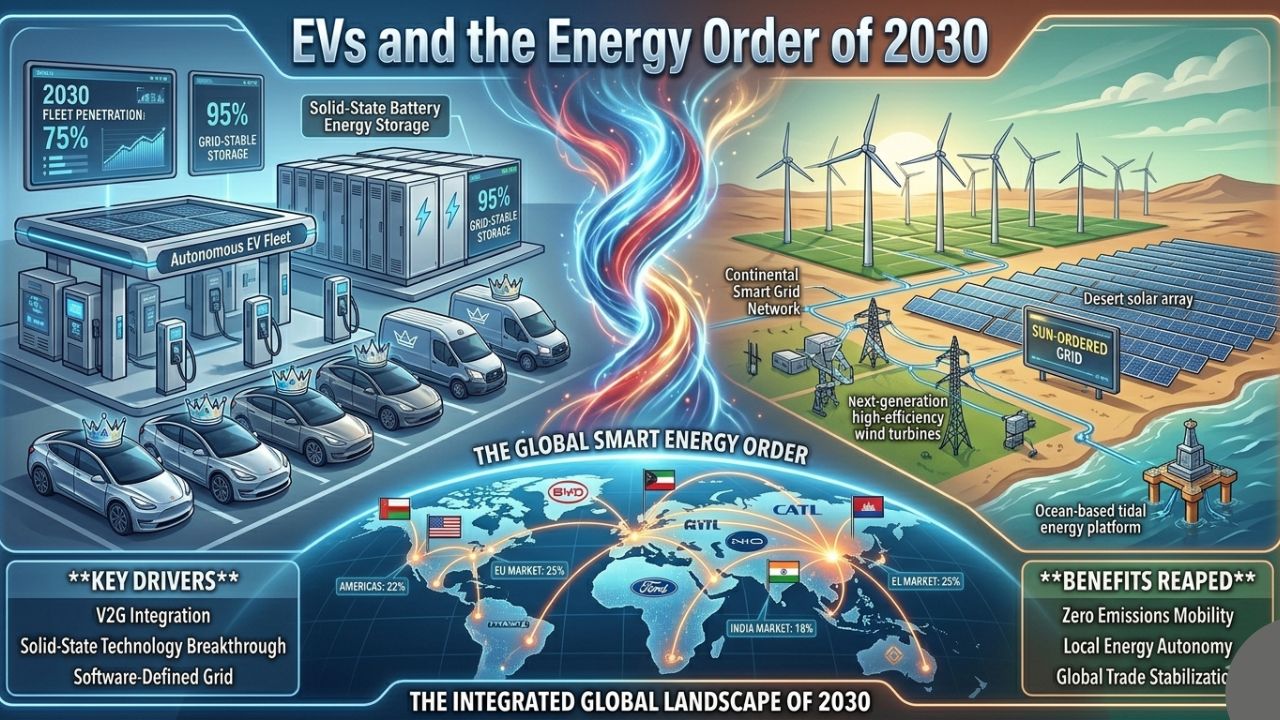
The Road Ahead — EVs and the Energy Order of 2030
Oil Demand Peak and the Petro-Economy Transition
The most consequential long-term implication of the global EV boom isn’t about car sales, brand rivalries, or even climate targets. It’s about what happens to oil demand — and by extension, to the entire geopolitical architecture built around petroleum revenues over the past century.
Expanding EV adoption is continuing to reduce oil demand, with oil displacement growing by 30% to over 1.3 million barrels per day in 2024 — equivalent to Japan’s entire transport sector oil demand today. IEA
Road transport oil demand is expected to peak in 2029. EV deployment across all vehicle modes could displace more than 5 million barrels of oil per day in 2030, with around half of those savings coming from China alone. Medium
Across all vehicle modes, the deployment of EVs replaces the use of more than 5 million barrels of oil per day globally in 2030 — an important energy security consideration. IEA
Think about what 5 million barrels per day of avoided oil consumption means in practice. It means petro-states — Russia, Saudi Arabia, Iran, Venezuela — face structurally declining revenues. It means the geopolitical leverage that energy exporters have wielded for decades begins to erode. It means the very conflict that accelerated the EV boom — Russia’s invasion of Ukraine, and the energy weaponization that followed — ultimately contributed to its own undoing by galvanizing the global energy transition.
There’s a historical irony of almost poetic dimensions there. The conflict that was meant to demonstrate the power of fossil fuel dependency instead catalysed the greatest single acceleration of the post-fossil-fuel transition in history.
Solid-State Batteries and the Next Technological Leap
The EV transition is not simply a story of scaling existing technology. It is simultaneously a story of rapid, consequential innovation — and the next chapter is already being written in battery labs across Japan, South Korea, China, and the United States.
Solid-state batteries are now being commercialised and are expected to account for 10% of global EV and energy storage battery demand by 2035. These next-generation batteries offer significant advantages in safety and energy density and are expected to be deployed in high-performance, premium vehicles first. Manufacturers have announced over 830 gigawatt-hours of annual solid-state battery capacity, but only 9.5% of this has been commissioned. BloombergNEF
Solid-state batteries replace the liquid electrolyte in conventional lithium-ion cells with a solid material — eliminating fire risk, improving energy density significantly, and enabling faster charging. When commercialised at scale, they have the potential to extend EV range beyond 800–1,000 km per charge, reduce charging times to under 10 minutes, and dramatically shrink the battery pack size for equivalent range — addressing virtually every remaining consumer objection to EV adoption in a single technology generation.
EV battery demand continues to grow, and is expected to reach more than 3 TWh in 2030 in the STEPS, up from about 1 TWh in 2024. The contribution of electric trucks to EV battery demand triples by 2030 to reach more than 8%, up from nearly 3% in 2024. IEA
The New Auto Manufacturing Geography — Who Wins, Who Loses
The geographic redistribution of automotive manufacturing power is already well underway, and by 2030 it will be dramatically more pronounced than today.
China is cementing its position not just as the world’s largest EV market but as its dominant manufacturing hub and technology exporter. China is still setting the pace. Europe has regained momentum. The United States remains important, but less central to the global story than once assumed. Emerging markets are moving from the margins to the core of the forecast. Medium
Europe — despite policy challenges and subsidy uncertainty — retains strong advantages in premium EV manufacturing, battery gigafactory development, and regulatory framework credibility. Volkswagen, BMW, Mercedes-Benz, Stellantis, and Renault are all fighting hard to maintain relevance in a market being transformed beneath them.
The most dramatic geographic shift may be in Southeast Asia and South Asia. Vietnam (VinFast), Turkey (Togg), India (Tata Motors, Mahindra), and Indonesia are all developing meaningful domestic EV manufacturing capabilities. Rapid growth in these emerging markets is attributable to increases in domestic manufacturing, growing access to affordable models, and consistent policy support. International Council on Clean Transportation
Projected EV Market Structure by 2030:
| Region | Projected EV Sales Share | Key Driver |
|---|---|---|
| China | ~60% | Domestic policy + affordability |
| Europe | ~35–40% | Emissions regulations + infrastructure |
| Southeast Asia | ~25% | Policy support + Chinese imports |
| USA | ~20% | Private sector momentum |
| India | ~15%+ | Domestic manufacturing scale |
| Latin America | ~10%+ | Chinese exports + local assembly |
Energy Security Redrawn — The World After Peak Oil Demand
We are entering a period of profound energy system transition — not just in transportation, but in the entire geopolitical architecture that fossil fuel dependency has shaped for over a century.
EVs are reducing oil demand at an exponential rate. Every time EVs save another million barrels of oil, it is set to happen in half the time. From early two-wheelers to current cars and future trucks, all vehicle segments can play a role in reducing pollution and increasing energy security. RMI
The nations that move fastest and most decisively into the EV era — building domestic manufacturing capacity, securing mineral supply chains, deploying charging infrastructure, and developing next-generation battery technology — will be the ones that shape the energy security landscape of the 2030s and beyond.
Those that hesitate, distracted by short-term commodity economics or political opposition, risk finding themselves as passive consumers in an industry architecture designed and dominated by others. The conflict that triggered this global auto pivot has made that choice starker than any policy document or climate model ever could.
The future of electric vehicles isn’t a distant prospect — it’s being decided in factories, government ministries, battery labs, and charging networks right now. And the countries and companies that understand what’s truly at stake are acting accordingly.
Conclusion — Conflict as Catalyst, EVs as Consequence
The story of the global EV boom is ultimately a story about how crises compress timelines. What might have taken two more decades of gradual technology adoption and policy nudging was accelerated into five years by the brutal logic of energy insecurity.
Russia’s invasion of Ukraine didn’t create the EV transition — the technology, the economics, and the environmental imperative were already pointing in that direction. But it did something arguably more powerful: it gave the transition urgency. It made energy security personal for consumers, existential for governments, and urgent for automakers. It turned the electric vehicle from a virtuous lifestyle choice into a strategic national interest.
Today, the global electric vehicle market stands at an inflection point. Massive sales volumes, surging adoption rates, and expanding infrastructure signal an irreversible shift toward electrified transport. More than one in four cars sold in 2025 is expected to be electric. Vietnam’s EV penetration rivals Europe’s. BYD has dethroned Tesla. Megawatt chargers are redefining what fast charging means. And the global oil market is staring down the barrel of structural demand decline. feyreeIEA
The conflict that shocked the world into action has, paradoxically, helped set in motion the energy transition that may ultimately make such conflicts less lucrative — and therefore, perhaps, less likely. The pivot has happened. The electric age is here. The only question now is who leads it. Explore the full depth of this transformation at internationalelectriccar.com, your definitive source for global EV news, data, and analysis.