What is the most cost-effective way to scale commercial EV charging infrastructure? For an increasing number of site hosts, the answer is Charging-as-a-Service (CaaS)—a subscription-based operational model where a third-party provider completely funds, installs, and maintains the physical stations.
This definitive guide breaks down how CaaS eliminates upfront risk, how intelligent management software protects your local grid capacity, and how to determine if a service-based model aligns with your property’s bottom line.
What is Charging-as-a-Service (CaaS)?
To understand how the commercial landscape is evolving, we have to look past physical hardware and focus on operational delivery.
EV Charging-as-a-Service (CaaS) is an all-inclusive, subscription-based deployment model where a specialized provider supplies, installs, owns, and maintains electric vehicle supply equipment (EVSE) on a host’s property in exchange for a predictable monthly fee or revenue-share agreement.
Instead of treating EV charging infrastructure as an asset-heavy capital investment, CaaS reclassifies infrastructure into an asset-light, fully managed operating expenditure (OpEx). The property owner provides the parking spaces, while the provider assumes the technical and financial risks.
Traditional Procurement (CapEx) —> High Upfront Cash Outlay + Long-term Maintenance Liability
Charging-as-a-Service (OpEx) —> $0 Upfront Capital + Predictable Monthly Subscription & Guaranteed Uptime
The Turnkey Infrastructure Bundle
A true B2B Charging-as-a-Service model is an “out-of-the-box” program that addresses every phase of the infrastructure lifecycle. When evaluating a turnkey provider, the framework typically encompasses five core layers:
- Site Design & Grid Interconnection: Conducting initial load capacity audits, managing utility permitting, and coordinating civil engineering constraints.
- Hardware Procurement & Installation: Sourcing commercial-grade Level 2 or DC Fast Chargers and executing the physical installation.
- CSMS Software Orchestration: Connecting the physical units to an open-standards network platform (such as an OCPP-compliant management software) to handle access control, power distribution, and billing.
- Proactive Maintenance & SLA Guarantees: Managing continuous remote monitoring, handling firmware updates, and dispatching local technicians to meet strict uptime metrics.
- 24/7 Driver Support: Providing customer service lines directly to motorists at the plug, resolving payment issues without interrupting property management operations.
By unbundling the hardware from localized ownership, commercial properties can scale their charging footprints rapidly to meet surging driver demand without tying up their internal capital or technical personnel.
CapEx Ownership vs. CaaS—A Deep B2B Comparison
For corporate financial officers, procurement teams, and commercial real estate portfolio managers, evaluating EV infrastructure is a balance-sheet decision. Deciding between a traditional Capital Expenditure (CapEx) purchase model and an Operating Expenditure (OpEx) Charging-as-a-Service (CaaS) subscription requires weighing short-term cash optimization against long-term operational liabilities.
The operational vectors below outline the differences between self-managed capital ownership and turnkey service deployment.
The Operational Breakdown
| Financial & Operational Factor | Traditional CapEx Ownership Model | Charging-as-a-Service (CaaS) Model |
|---|---|---|
| Upfront Capital Allocation |
High Initial Cash Outlay: Demands complete funding for hardware procurement, extensive trenching, transformer upgrades, and engineering fees. |
$0 Upfront Investment: Eliminates initial deployment friction; capital costs are fully absorbed by the turnkey service provider. |
| Accounting & Balance Sheet Impact |
Asset Depreciates: Enters the balance sheet as a long-lived physical asset subject to standard corporate depreciation schedules. |
Predictable OpEx: Classified as an operating expense, allowing for a straight-line, predictable impact on your Profit & Loss (P&L) statement. |
| Technology Obsolescence Risk |
High: The site host owns the physical hardware. If charging speeds or standard connectors shift, the host faces stranded asset risk. |
Low: The technology roadmap is shifted to the provider. System upgrades and hardware migrations are managed via the service contract. |
| Maintenance Liability & Downtime Costs |
Internal Cost Center: Site hosts manage unexpected repair bills, part sourcing, truck rolls, and the hidden revenue losses of offline plugs. |
Guaranteed Uptime via SLA: Maintenance liabilities sit entirely with the provider, governed by strict Service Level Agreements (SLAs) for remote and physical remediation. |
| Revenue Structuring & Margins |
100% Margin Retention: The property owner retains all net revenue generated by driver usage after paying utility costs. |
Tiered Revenue Share: Yields a predictable, lower-risk revenue share or subscription payout balanced by zero operational overhead. |
Key Financial Traps in Self-Managed CapEx
When modeling the true cost of ownership, financial analysts frequently look only at the hardware “sticker price”. A self-managed CapEx model, however, exposes commercial enterprises to two distinct variables:
1. The Unpredictable Civil Engineering Multiplier
The cost of an EV charger hardware unit is fixed, but the cost to connect it to the grid is not. If your site requires a new utility transformer, extensive directional boring beneath asphalt, or a dedicated switchgear upgrade, your initial installation costs can easily scale to double or triple the cost of the hardware. Under a CaaS agreement, these variable civil risks are assumed by the provider during the site evaluation phase.
2. The Multi-Tenant Operational Burden
Managing a charging network requires significant back-end resources. Internal teams must handle billing reconciliation across multiple departments, manage payment card industry (PCI) data security compliance, adjust charging prices to match fluctuating utility demand charges, and troubleshoot hardware failures. For lean facilities teams, the ongoing operational drag of managing a public or employee network can quickly degrade the projected return on investment (ROI) of a self-owned asset.
For corporate compliance teams navigating FASB ASC 842 lease accounting rules, well-structured CaaS agreements can be designed strictly as service contracts rather than capital or operating leases. This arrangement keeps the charging network off your debt-to-EBITDA leverage ratios entirely, allowing you to scale sustainability initiatives without impacting core borrowing power.
How the CSMS Software Platform Drives CaaS Functionality
A common misconception in commercial real estate is that Charging-as-a-Service is simply a creative financing vehicle. In reality, a CaaS model is only as viable as the central Charging Station Management System (CSMS) driving it behind the scenes.
Because the service provider shoulders all structural risk and uptime commitments, they rely on enterprise-grade software to protect their margins while delivering a seamless driver experience. Three core software mechanisms—anchored in open standards and cloud architecture—turn a standard charging plug into an automated, risk-managed utility asset.
1. Dynamic Load Management (DLM) & Intelligent Energy Allocation
The greatest operational hurdle for any multi-charger site host is managing fixed electrical power limits that were never originally designed for simultaneous EV charging demand. Rather than forcing expensive, multi-month utility infrastructure upgrades, a modern CSMS utilizes software-driven coordination to treat all chargers at a site as a single, synchronized network.
EV Connect’s EV charger load management capabilities built into the platform continuously balance available power across charging stations using two core real-time optimization capabilities:
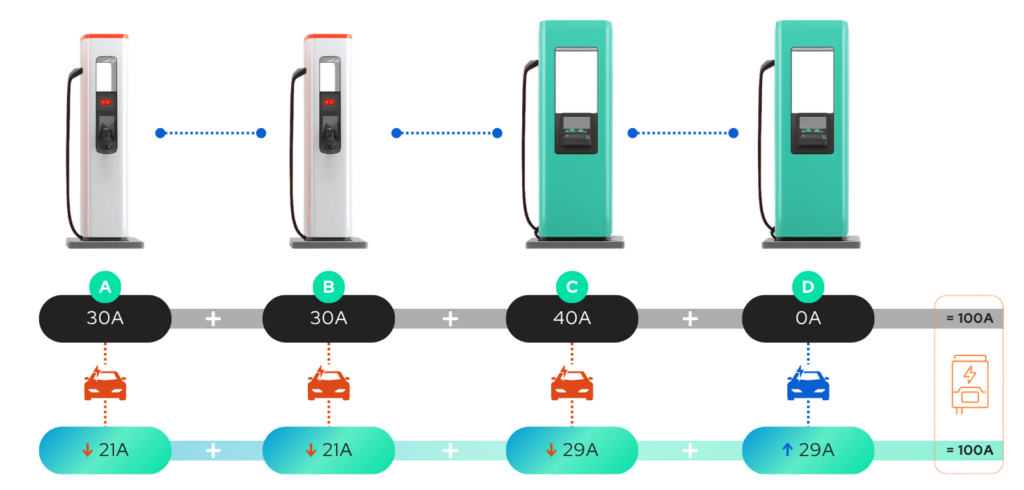
- Proportional Load Sharing: When an additional vehicle plugs in, the CSMS instantly recalculates the site’s capacity. Instead of overloading a breaker, it dynamically redistributes power by scaling down individual outputs proportionally (for example, fluidly adjusting four active chargers down to balanced 21-amp and 29-amp draws to stay strictly under a safe 100-amp threshold).
- Fleet Vehicle Optimization: For delivery networks and logistics depots, the software prioritizes energy distribution based on a vehicle’s specific duty cycle, route configurations, and on-time departure requirements rather than splitting power equally.
2. Granular Tariff Engineering & Access Customization
A flexible CaaS deployment requires highly customizable monetization mechanics to help site hosts curb energy use during expensive on-peak windows and avoid costly peak demand charges.
Through advanced tariff engineering, operators can establish multi-tiered pricing rulesets from a centralized dashboard:
- Time-of-Use (TOU) & Session Billing: Configuring structural automated adjustments that match fluctuating utility demand tariffs or charge drivers based on exact session durations.
- Segmented Access Control: Tailoring unique rules for distinct driver groups—such as automating delayed charging scripts to capitalize on cheap overnight off-peak windows for fleet vehicles, providing flat-rate discounts for workplace employees, and setting premium public tiers for retail consumers.
- Automated Grid Integration: Leveraging native integration with protocols like OpenADR 2.0b to participate in automated utility demand response programs, turning a property’s charging footprint into a grid-interactive asset.
3. Open Standards (OCPP) vs. Proprietary Lock-In
The long-term viability of a CaaS framework hinges on avoiding closed, proprietary ecosystems that blend hardware, software, and network services into a single inseparable bundle (such as full-stack models like ChargePoint). Closed networks expose site hosts to heavy vendor lock-in; if pricing models shift or per-session driver fees rise unexpectedly, migrating away often forces an expensive “rip-and-replace” of the physical stations.
By contrast, enterprise CaaS platforms utilize an open, hardware-agnostic architecture built on the Open Charge Point Protocol (OCPP)—supporting OCPP 1.6J smart charging profiles and forward compatibility with OCPP 2.0.1. Because the network communication standard is decoupled from the physical equipment, it enables two critical business advantages:
- Mixed Hardware Support: Site hosts can mix and match different Level 2 charger brands across a portfolio under a single management interface based on cost or specific site layouts.
- Seamless Re-Networking Pathways: If a provider change is ever required, the chargers can be migrated via a standard over-the-air firmware update that points the station to a new OCPP WebSocket URL, entirely eliminating physical site labor and protecting the underlying hardware investment.
Capital vs. Operational Expenses — Choosing the Right Financial Model for Your Charging Infrastructure
Deploying commercial EV charging infrastructure requires a strategic financial approach. For site hosts, the decision typically comes down to a choice between a Capital Expense (CapEx) purchase model and an Operational Expense (OpEx) procurement model, such as EV Charging-as-a-Service (EV CaaS).
Choosing the right path depends heavily on your corporate tax strategies, available upfront capital, and how much hands-on operational risk your business is willing to assume.
The CapEx Model: Direct Ownership and Control
Under a traditional CapEx model, your business purchases the EV charging hardware and pays for the installation upfront.
- Financial Impact: High initial capital outlay, but the hardware becomes a depreciable corporate asset on your balance sheet.
- The Advantage: Long-term return on investment (ROI) can be higher because you retain 100% of the charging revenue (minus utility costs and network software fees) once the initial hardware and installation costs are amortized.
- The Catch: You bear full responsibility for the total cost of ownership. If a charging station goes offline, requires hardware replacement, or suffers vandalism outside of the warranty period, your internal teams must manage and fund the repairs.
The OpEx Model: Predictable, Low-Risk Charging-as-a-Service
For businesses looking to conserve capital or avoid the logistical overhead of managing infrastructure, the OpEx-driven EV CaaS model acts as an all-inclusive subscription framework.
- Financial Impact: Minimal upfront costs. Hardware, site software, installation, and ongoing maintenance are bundled into a single, predictable monthly operating fee.
- The Advantage: This model completely removes the burden of long-term maintenance and risk from the host. Hardware procurement, network operations, routine firmware updates, and rapid on-site break-fix repairs are handled entirely by your charging partner.
- The Catch: Because the service provider absorbs the infrastructure risk and hardware costs, a portion of the charging revenue or a flat subscription fee goes toward covering the service, meaning it takes longer to reach direct profitability compared to an owned asset.
| Financial Dimension | CapEx (Direct Purchase) | OpEx (Charging-as-a-Service) |
|---|---|---|
| Upfront Capital |
High: Requires a significant upfront investment covering hardware procurement, installation, and other deployment costs. |
Very Low: Costs are shifted to a predictable monthly service fee, reducing initial financial barriers. |
| Asset Ownership |
On-Balance Sheet: Charging infrastructure is owned by the site host and treated as a depreciable capital asset. |
Off-Balance Sheet: Infrastructure is provided as a service, with costs categorized as an operating expense. |
| Maintenance & Uptime Risk |
Site Host Responsibility: The owner manages maintenance, repairs, vendor coordination, and charger uptime. |
Provider Managed: Maintenance, monitoring, and performance obligations are handled through the service agreement. |
| Ideal For |
Maximum Revenue Control: Organizations seeking ownership benefits and long-term control over charging revenue. |
Cash Flow Preservation: Businesses focused on conserving capital, reducing operational burden, and accelerating deployment. |
If your organization has access to immediate cash flow, dedicated facility managers, and clear tax incentives to write off capital equipment, the CapEx model maximizes asset utilization. If you prefer to protect your capital reserves, bypass maintenance headaches, and guarantee a high uptime SLA via an all-in-one program, the OpEx CaaS model is your fastest path to deployment.
EV Charging-as-a-Service (EV CaaS) is a turnkey procurement model that allows businesses to deploy EV charging stations as an operational expense (OpEx) rather than a major capital investment (CapEx). Instead of buying the hardware and paying for installation upfront, the site host pays a predictable monthly subscription fee. This fee typically bundles together the physical charging units, hardware commissioning, network management software, proactive monitoring, and all ongoing maintenance or hardware replacements.
Commercial site hosts can generate revenue by establishing custom driver pricing policies through their charging station management software. The three main monetization structures are:
Commercial Level 2 AC chargers typically range between $3,500 and $15,000 per port, including hardware and standard installation, making them highly cost-effective for long dwell-time properties like workplaces or multifamily housing. DC Fast Chargers (DCFC) range from $18,000 to over $350,000 per unit depending on the kilowatt output. DCFC systems require a significantly larger capital layout due to advanced power electronics, the necessity of step-down utility transformers, heavy-duty concrete trenching, and dedicated grid interconnection upgrades.
To run a reliable, cost-efficient commercial charging setup, your network software must offer four core functionalities:
EV Connect is a full-service EV charging partner, offering end-to-end support from incentive guidance and site assessment to hardware, installation, software, warranties, and 24/7 customer support—all designed to simplify deployment and ensure long-term station reliability and performance.
Our 16+ years of charging expertise bring it all together seamlessly, backed by Schneider Electric, the world’s most sustainable company.*
Request a Quote or Contact us today and find out why CPOs, OEMs, utilities, and more trust EV Connect to run their businesses!