Public Information Act Request Reveals Weights and Measures Funding Agreement
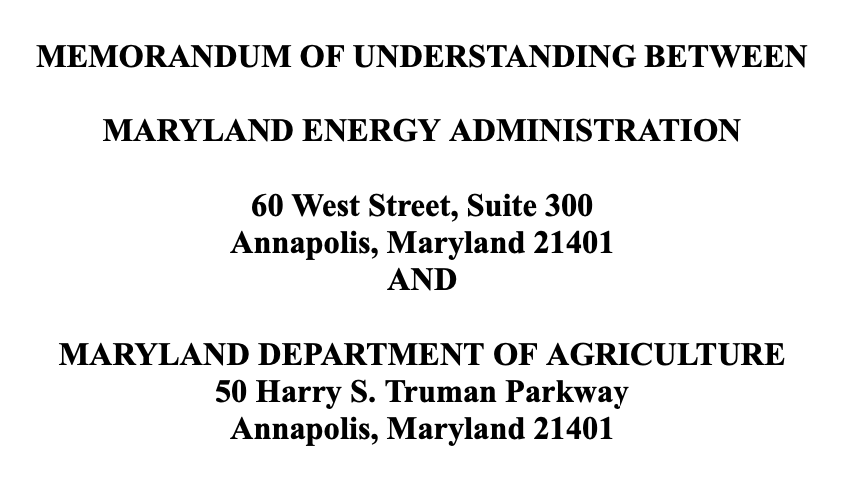
A signed Memorandum of Understanding obtained through a Public Information Act request reveals that the Maryland Energy Administration has committed up to $900,000 from the Maryland Strategic Energy Investment Fund to cover the startup costs of the Maryland Department of Agriculture’s EVSE Weights and Measures inspection, testing, and reporting program. Based on the MOU’s terms, an upfront disbursement of $511,876 for equipment and supplies may already have been transferred to MDA.
That money comes from you.
Where SEIF money comes from
SEIF is funded primarily through revenues from the sale of allowances under the Regional Greenhouse Gas Initiative, a cap-and-trade program for power sector carbon emissions. Maryland electric utilities purchase those allowances and pass the cost through to their customers. Every Maryland electric bill carries a share of that cost. The fund exists to support renewable energy programs, clean energy initiatives, and greenhouse gas reduction. Think solar panels, energy efficiency upgrades, electric school buses, and low-income energy assistance. It was not created to cover the startup costs of a state agency’s regulatory administration program.
MEA’s justification
MEA’s legal rationale, stated in the MOU’s recitals, is that “ensuring the accuracy, reliability and efficiency of Maryland’s publicly available EV charging network supports the statutory intent of §9–20B–05 by enabling greater EV adoption and contributing to measurable reductions in greenhouse gas emissions, energy consumption, and fossil fuel use.” That argument is worth examining closely.
The MOU contains no reporting metrics tied directly to greenhouse gas reduction outcomes. There is no estimate of emissions avoided. There is no calculation of gallons of gasoline displaced by EV drivers using accurately metered chargers. Those are the kinds of measurements that would demonstrate a genuine connection to SEIF’s statutory purpose. Without them, the rationale is simply an assertion.
A more fundamental question
Maryland law is specific about how SEIF funds can be spent. State Government Article Section 9-20B-05(k) requires that expenditures from the Fund be made by appropriation in the annual State budget or by budget amendment under Section 7-209 of the State Finance and Procurement Article. If a budget amendment is used, Section 9-20B-05(l) requires that MEA submit the proposed amendment and supporting documentation to four legislative committees and give those committees 45 days for review and comment before the amendment takes effect.
The MOU is neither an appropriation nor a budget amendment. It is an interagency agreement. Whether the proper expenditure mechanism was followed has not been publicly addressed.
The legislature said no
The statutory authority question does not stop at process. Earlier this session, the Maryland General Assembly was asked to add explicit authorization for exactly this use of SEIF funds. HB 1225 contained language that would have added a new provision to Section 9-20B-05 authorizing SEIF to pay costs associated with inspection and testing of weights and measures used for the retail sale of electricity as a motor fuel. That bill died without advancing.

MEA and MDA executed this MOU without the authorization the legislature was asked to provide and declined to enact.
The current statute contains one precedent for using SEIF to fund a state agency’s regulatory administration function. Section 9-20B-05(f)(13) explicitly authorizes SEIF to pay costs associated with the Air and Radiation Administration within the Maryland Department of the Environment. That authorization was added deliberately by the legislature presumably because it knew such a use would otherwise not fit the statute’s enumerated purposes. The legislature was asked to add an equivalent authorization for MDA’s Weights and Measures program. It did not.
Why this matters
This is not a small procedural question. It goes to whether ratepayer funds are being directed to a purpose the legislature has not authorized, through a mechanism the statute does not provide for, in a program whose fee level depends on that outside funding to remain viable. Without the $900,000 SEIF commitment, the $75 per port fee may not be sustainable. The program is being built on a financial foundation that has not been publicly scrutinized and may not be legally sound.
If you share these concerns, contact your state legislators and ask why SEIF funds meant for energy savings and greenhouse gas reduction programs are being allocated to a Weights and Measures inspection program instead of going toward things like solar panels, energy efficiency upgrades, and electric school buses.
The signed MOU is available here.
Related
Discover more from Plug-In Sites
Subscribe to get the latest posts sent to your email.