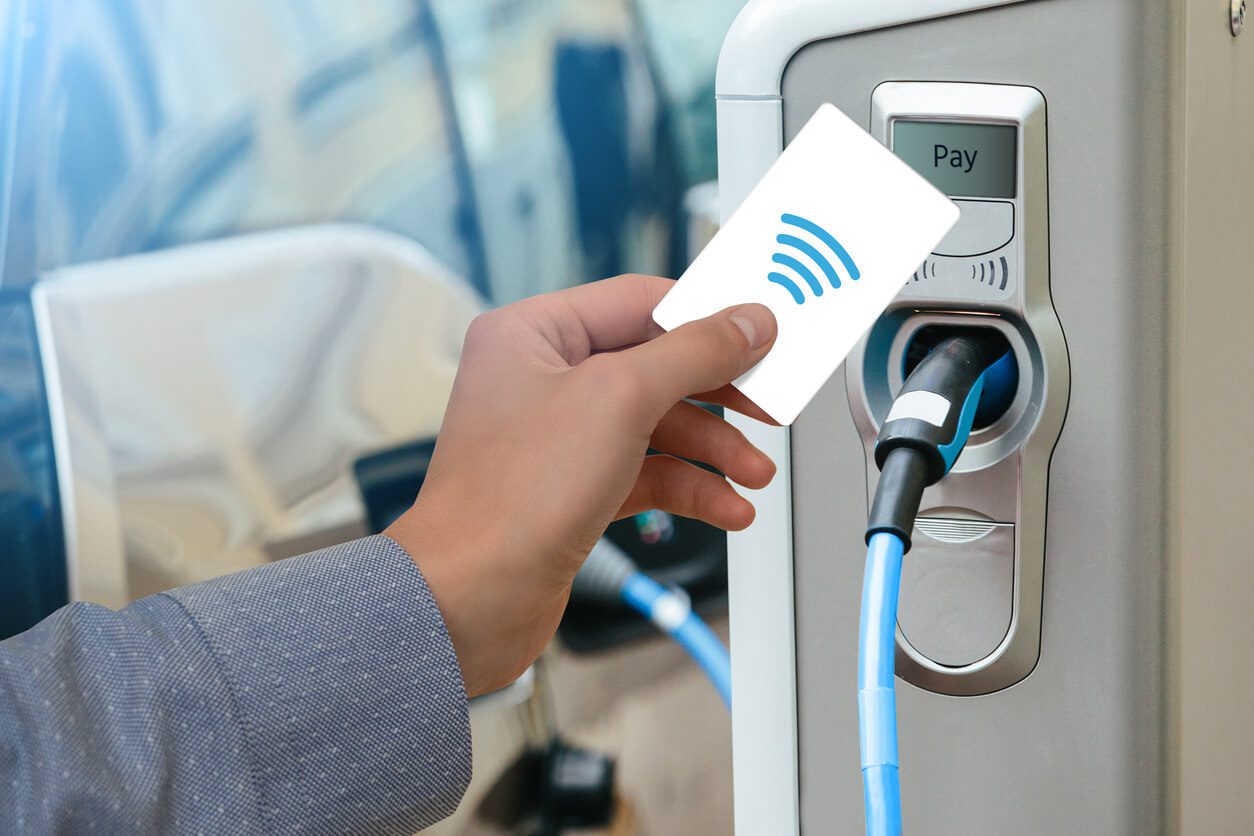
They are quick and easy to use, allowing drivers to start and stop charging sessions with a simple tap. After the initial setup, RFID cards confirm their users’ identities and authorise payments efficiently. As EV charging stations popped up around the country, RFID cards increased in popularity and fast became the preferred choice of payment for many users.
How An RFID Card Works
Believe it or not, RFID cards have been around since the 1930s. During wartime, the ‘Identify Friend or Foe’ (IFF) system was developed by British forces. This system was an early method of RFID that used radio waves to identify friend or enemy aircraft planes.
RFID stands for Radio Frequency Identification. The technology uses wireless radio waves to send and receive information stored in a small chip, called an RFID tag. When the RFID card or tag is placed near a reader, the reader emits a radio signal, and the tag responds in a certain pre-programmed way, e.g. to make a payment or unlock a charger.
All RFID systems require three components: a reader, an antenna, and a tag. The reader transmits and receives data, the antenna converts the signal into radio waves, and the tag stores and transmits information.
There are several different types of RFID EV cards. Read on to discover more…
What Are the Different Types of RFID Cards?
RFID technology has undergone significant advancements since its wartime inception. What was once a specialised tracking facility is now used extensively across most industries to make payments, code and track production, manage storage, track assets, and much more. In fact, RFID is even used in the Vatican to monitor the inventory and movement of over two million manuscripts! In the EV charging world, several types of RFID cards are available.
Network-Specific RFID Card
Most charging station networks offer their own RFID card system. They usually offer benefits and discounts to increase brand loyalty and priority access to their charging stations. Members benefit from exclusive deals and points-related bonuses.
Fleet RFID Card
Fleet cards offer centralised billing, streamlined reporting, and increased cost control for businesses with multiple electric vehicles. Usually, employees can only charge at designated charging stations. Businesses can often negotiate favourable terms and payment plans for their valuable commercial account.
Universal RFID Card for EV Charging
If you’re a well-travelled EV owner driving varied routes, you probably have several RFID EV cards tucked away in your wallet. But wouldn’t it be great if you only needed one card to authorise transactions wherever you are, and whichever network you stop at?
The Universal RFID Card provides the ultimate convenience for EV drivers, enabling them to access multiple charging networks with a single card or app. Universal cards offer complete flexibility where drivers can charge at many stations, regardless of which network they belong to.
There is no need to sort through a plethora of cards until you find the right one to pay; simply present your universal RFID card to initiate, authorise and pay for your EV charge. Some providers also offer discounts and other perks to tempt drivers into visiting participating charging stations.
Using an RFID Card for EV Charging

As an EV owner, using an RFID charge card to initiate charge sessions, confirm identity and authorise payments can streamline the charging process massively. When your vehicle is running low, simply locate a compatible charge point and follow the steps below:
- Park your vehicle and connect it to the charger.
- Tap your RFID card on the reader to initiate charging. If you’re not sure, look for the RFID symbol.
- The charging station will indicate when the session has been authorised. Usually, there will be a message or light to confirm approval.
- Begin charging!
- When you have finished charging, tap the card on the reader again to end the session. Sometimes, the session ends automatically when the vehicle is unplugged.
- You’ll receive a paper or email receipt confirming the charge session.
There are lots of benefits to using an RFID card for EV charging; it’s super quick and convenient, it’s reliable, even in areas with poor network coverage, and you can often earn points when you fill up.