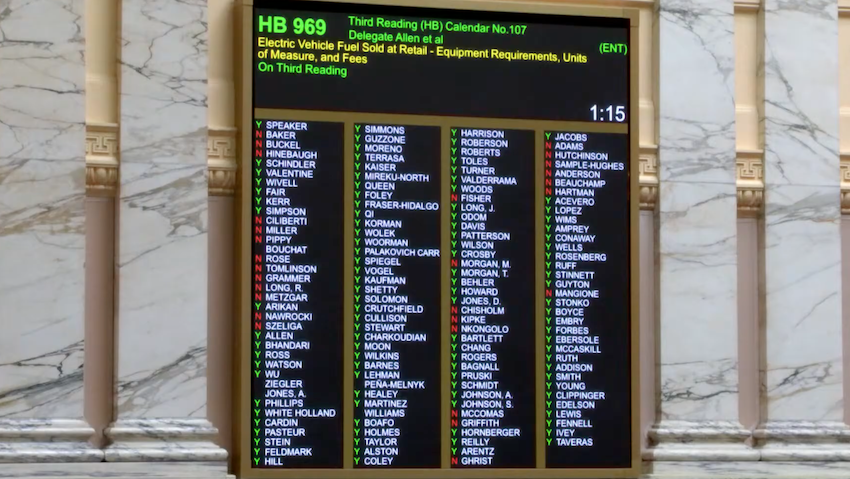
House Bill 969, the Electric Vehicle Fuel Sold at Retail bill sponsored by Delegate Nick Allen, passed the Maryland House of Delegates today on third reading following amendments adopted last week in the Agriculture and Aquaculture Subcommittee. The bill now moves to the Senate, where the companion bill, SB 649, did not advance before crossover.
What the bill does
As amended, HB 969 requires owners of EV charging equipment to display contact information for a responsible local party, requires that electricity be sold in kilowatt-hour units, limits charges to kilowatt-hours actually dispensed during a session, allows ancillary fees applied at the conclusion of a session, and requires those fees to be itemized on the customer’s receipt.
Opposition that was not acknowledged
During floor debate ahead of the vote, Delegate Christopher Adams of the Eastern Shore asked the bill’s floor leader, Delegate Natalie Ziegler, whether there had been any opposition to the bill as amended. Delegate Ziegler replied that she was not aware of any.
In fact, three parties submitted unfavorable testimony on the bill: Tesla, whose managing policy advisor testified at the February 27 hearing; Advanced Energy United, a national clean energy trade association; and me, who testified at the hearing and submitted a follow-up email to the full committee after the subcommittee amendments were adopted. My email argued that the amendments did not close the core consumer protection gap in the bill.
The question that went unanswered
Delegate Adams also asked how taxes apply to EV charging fees. The floor leader acknowledged the bill does not address that, and Environment and Transportation Committee Chair Marc Korman described the EV registration surcharge and a sales tax on public charging being directed to the Transportation Trust Fund adopted in recent sessions. However, the specific tax question raised in my email to the committee was not addressed: the sale of electricity at public EV charging stations is subject to Maryland’s 6% sales and use tax, but parking fees typically are not. When operators charge $0.00/kWh for electricity and recover the full cost of a charging session through a time-based parking fee, the transaction may escape the sales tax that would otherwise apply to electricity fees. The Comptroller’s Office is currently investigating this question.
The loophole that remains and why this bill may not be worth passing
The amended bill still permits an operator to display $0.00/kWh as the electricity price while charging drivers the full cost of the session through an ancillary fee. This is not a hypothetical concern. It is a documented practice that Maryland Weights and Measures has already found to be in compliance with existing standards. The amended bill does nothing to change that finding.

The Maryland Department of Agriculture identified this problem in their own testimony and proposed specific language to fix it. The Maryland Energy Administration made a similar recommendation, drawing a parallel to Maryland’s existing prohibition on selling gasoline below cost. Neither proposal was adopted in the amendments.
As a practical matter, a charging station currently displaying no kWh price at all, which is non-compliant under the bill, could achieve technical compliance simply by adding a $0.00/kWh display alongside its existing time-based fees. The consumer would be no better informed about what they are actually paying for energy than before the bill existed. A law that can be satisfied by displaying a zero price for the commodity it is meant to protect is of questionable value to EV drivers.
The provisions that were adopted in the amendments, including itemized receipts, largely restate requirements already present in the NIST Handbook 44, which is incorporated into Maryland law through Agriculture Article 11-207.1. The bill does not close the $0.00/kWh loophole. What would address the loophole was proposed by two state agencies and set aside in the bill passed by the House.
What comes next
The bill now goes to the Senate Education, Energy, and Environment Committee. The Senate had its own hearing on the companion bill SB 649 in early March, at which the same consumer protection gaps were raised in written testimony. Senate consideration gives the committee an opportunity to address the language that was set aside in the House process. EV drivers who want transparent, comparable pricing at public charging stations should follow that process closely.
Related
Discover more from Plug-In Sites
Subscribe to get the latest posts sent to your email.