Full Control in Cathode Active Materials Synthesis for Battery R&D – enabling scalable, reproducible results.
In battery materials development, achieving consistent particle morphology is a major challenge. Parameters such as pH, temperature, and mixing strongly influence the size and shape of precursor particles, which in turn affect performance and manufacturability. As demand for high-energy-density batteries grows, researchers need reliable methods in the lab to produce commercially relevant cathode active material precursors (pCAM) under controlled conditions.
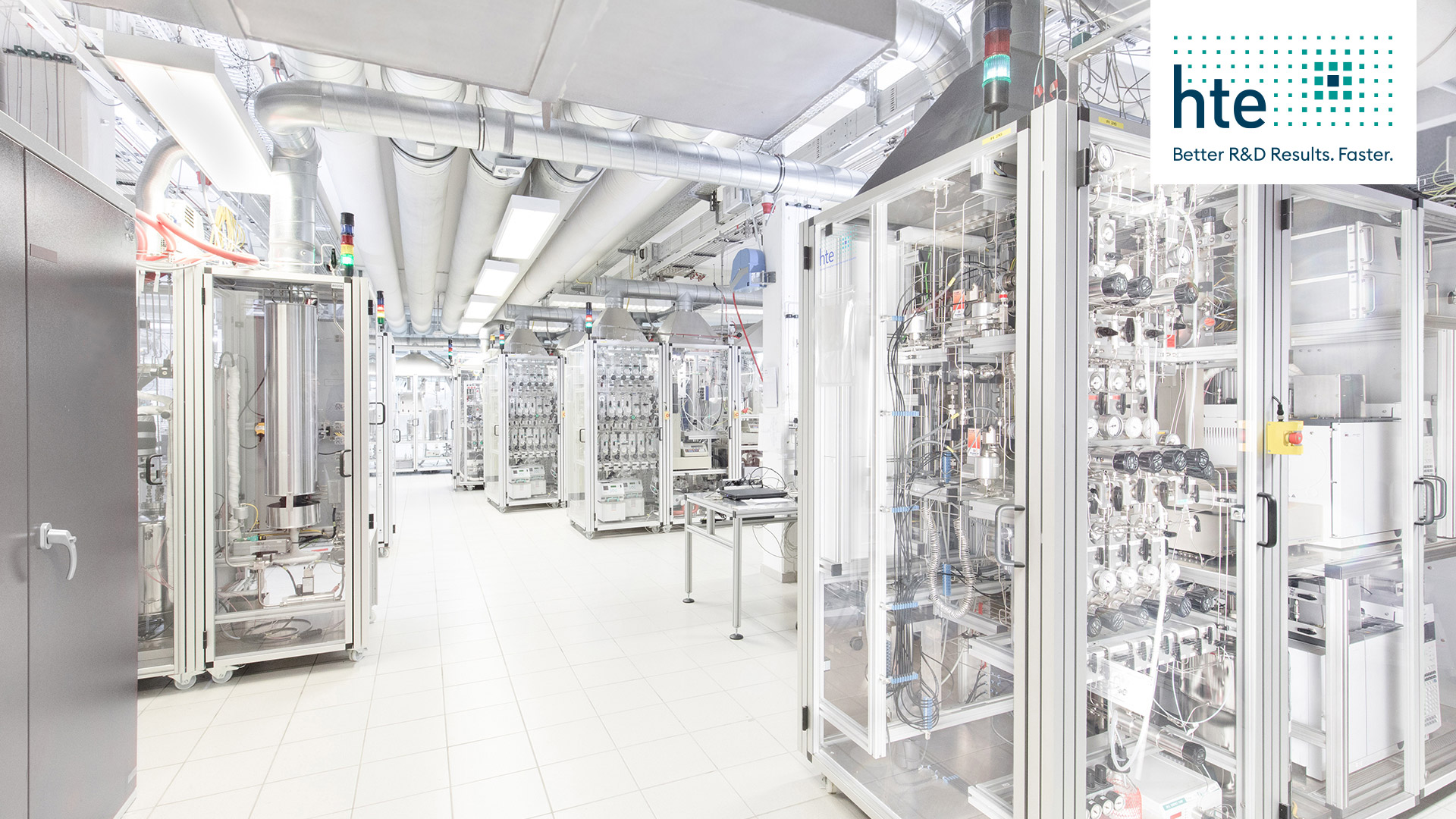
hte’s automated precipitation technology introduces a new benchmark in co-precipitation of cathode active material precursors (pCAM). The laboratory system enables precise control of pH, temperature, and particle size through integrated feedback loops and real-time monitoring, unlocking tailored performance and industrial scalability.
Why it matters
As battery manufacturers race to meet the increasing demands on electric vehicle performance and energy storage systems, the ability to precisely engineer cathode active materials is critical starting with high quality pCAM materials. Uniform, spherical particles improve packing density, filterability, and electrochemical stability—key factors for high-performance lithium-ion batteries. Beyond NCM chemistries, the platform supports advanced studies for LFP and sodium-ion materials.
The innovation
Producing cathode active material precursors with uniform particle size and morphology is critical for battery performance and manufacturability, but it’s also challenging. Variations in pH, temperature, and mixing can lead to inconsistent particle growth, impacting downstream processes and cell quality.
hte’s precipitation unit combines automated dosing, real-time pH and particle size monitoring, and modular operation modes (batch or continuous). hte shows this in the newly published case study for Ni-rich materials. Digital workflows and integrated feedback loops enable unattended operation and systematic parameter studies. In a 30-hour semi-batch run, the system synthesized NCM811 precursors with:
- D50 ≈ 11.6 µm: Narrow particle size distribution
- Spherical morphology: Verified via SEM (see Figure 1)
- Stable process control: Enabled by closed-loop feedback


The stable control of critical process parameters like dosing rates, stirring speed, and reactor temperature, throughout the 30-hour semi-batch run is key to achieving uniform particle morphology and reproducible synthesis results. This is possible at the hte’s precipitation plant. Figure 2 shows the flow rates of all metal sulfate solutions as well as NaOH, and NH₄OH over the reaction time.
Scalable, safe, and smart
To translate lab-scale experiments into commercially relevant results, flexibility and process safety are essential. hte’s precipitation technology combines automation with advanced control features to ensure reproducibility and scalability in battery materials R&D:
- 1–5 kg output per run
- 24/7 unattended operation with safety sensors
- Integrated feedback loops for real-time pH and particle size control
- Customizable workflows for doping, aging, or post-treatment
- Digital twin-ready: Full data traceability and automation

Setting a new standard
This newly published case study demonstrates how digital automation and full control over synthesis parameters enable researchers to conduct mechanistic studies, scale up efficiently, and explore multiple chemistries (Ni-rich, LFP, Na-ion)— empowering them to innovate, scale, and lead in the competitive battery materials space.
Are you interested in diving deeper into the results of the case study and learning how to optimize your processes through automated control, leverage data-driven insights, and accelerate your material development?
Download the case study “Synthesis of Cathode Active Precursor Materials for Battery R&D” by Qian Du, Christoph Ariaans, Nina Heene-Würl, Sara Claramunt, Florian Huber from hte here: https://www.hte-company.com/en/publication/rd-case-study-synthesis-of-cathode-active-precursor-materials-for-battery-rd/
About hte
Founded in 1999 and headquartered in Heidelberg, Germany, hte develops innovative R&D workflows on lab-scale. These workflows comprise reactor systems, precise analytics and software solutions. We combine two core strengths: Building laboratory systems for automated, high-quality experimentation and data generation, and running joint R&D research projects, creating a synergy that ensures better R&D results, faster. With our more than 400 employees and our in-depth application expertise, we are able to downscale commercial processes to lab-scale and quickly generate results with high data quality and commercial relevance to help our customers achieving their sustainability goals. For more information, visit our website www.hte-company.com.
Contact: Dr. Sara Claramunt
E-Mail: Sara.Claramunt@hte-company.de Phone: +49 151 5792 4218
References
1. R. B. Berk, T. Beierling, L. Metzger, H. A. Gasteiger, J. Electrochem. Soc. 2023, 170, 110513.
READ the latest Batteries News shaping the battery market