Plus, stay tuned because later I’ll tell you about Sony Honda’s second EV, before they’ve even sold their first one.
On EV News China today we’re talking about: BYD overtaking Tesla in Europe’s biggest markets, Geely’s new MPV and NIO’s millionth car.
Join me later for a bonus show called ‘Why Winning In Europe Is Crucial For BYD’. It will be live tonight for Patrons, and all Patreon exclusives go onto the free feed after 7 days. If you want the content first, it’s just one of the member benefits.
VOLVO EX60 WILL TRAVEL 505 MILES ON A SINGLE CHARGE
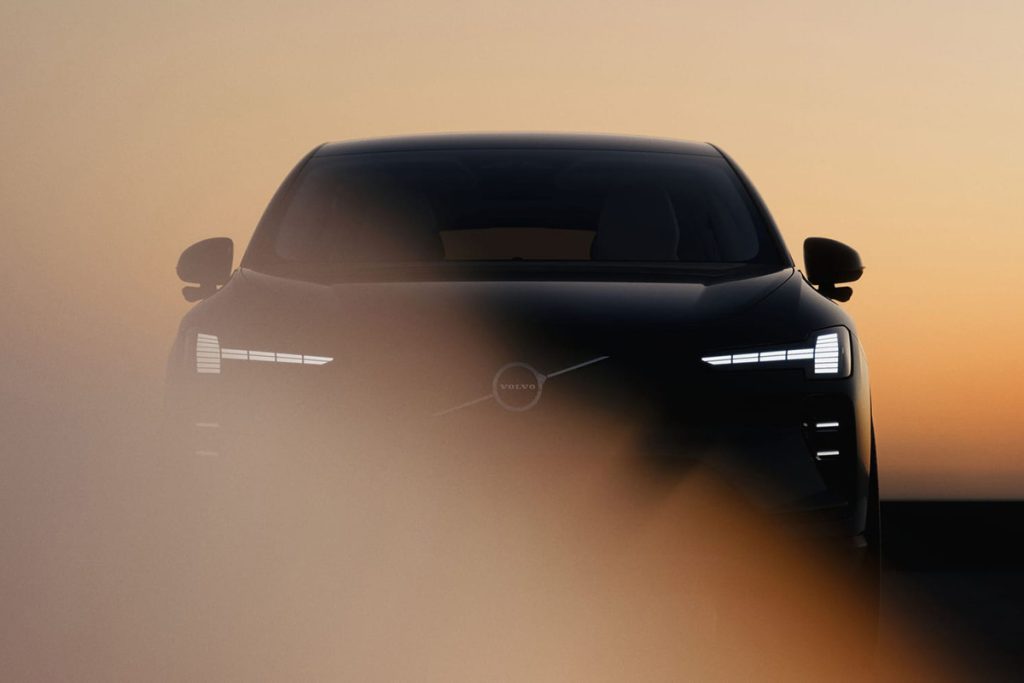
Volvo will unveil the EX60 in two weeks, a crossover it bills as its next-generation electric car and expects to sell in large numbers.
Even with four-wheel drive, the EX60 is claimed to manage 505 miles on the WLTP test. Its 800-volt electrical system is designed for fast charging. Turn up at a 400kW charger with 10-20% in the battery and, says Volvo, ten minutes should be enough to add about 210 miles. On paper, that puts the EX60 neck-and-neck to the new BMW iX3.
The EX60 also introduces fresh hardware under the skin. Volvo calls the new underbody, chassis and suspension SPA3, an evolution of the EX90’s SPA2 architecture rather than a clean break. At its core is a “cell-to-body” battery layout.
Instead of building cells into modules, then into a pack bolted under the floor, Volvo stacks the cells directly into the body structure. The battery casing becomes part of the car’s skeleton, adding stiffness to the shell and cell compartment while trimming weight and bulk.
Much of the EX60’s software stack, motors, battery and power electronics has been developed in-house. That tighter grip on hardware and code is meant to set the template for future electric models, which will share SPA3 and its integrated battery.
EX-VOLVO DESIGNER INGENLATH RETURNS AFTER LEADING POLESTAR
Thomas Ingenlath has resumed his post as Volvo’s chief designer, nine years after leaving Gothenburg to run its electric offshoot, Polestar. The move puts the German stylist back in charge of Volvo’s next generation of models, a role he first took in 2012.
During his first five-year spell at Volvo, Ingenlath led a redesign of the brand’s range. He shaped the XC90, V90 and XC40, which set the company’s current look, and created two concept cars.
The Concept Coupé foreshadowed the Polestar 1. The Concept 40.2 evolved into the Polestar 2.
In 2017 Volvo and Geely shifted Ingenlath from design into general management, appointing him CEO of Polestar as it was carved out as a separate manufacturer. Under his leadership, Polestar moved from design-led halo products to higher-volume EVs, with the Polestar 2 becoming its core model.
After leaving the chief executive role at Polestar, Ingenlath became a design adviser to the wider Geely group. He is now returning to Volvo to steer the styling of its next line-up, again teaming up with Håkan Samuelsson.
Samuelsson, Volvo’s chief executive during Ingenlath’s first tenure as design boss, stepped down in 2022 and returned to the company in 2025. After leaving Gothenburg to build an electric spin-off into a standalone brand, Ingenlath now comes back to the mothership to define its next generation of cars.
RENAULT TWINGO E-TECH ELECTRIC: PRICING AND SPECS ANNOUNCED FOR EUROPE
Renault’s new Twingo E-Tech electric will make its public debut at the Brussels Motor Show from January 9th to 18th, with orders opening on January 8th. Built on the AmpR Small platform, the city car launches at €19,490 for the Evolution trim before incentives. The Techno version starts at €21,200.
Both versions use a 60kW motor and a 27.5kWh lithium iron phosphate battery. Renault quotes a WLTP range of 263km. A 6.6kW AC charger is standard.
An optional charging pack adds an 11kW bidirectional onboard charger and 50kW DC fast charging. The Twingo supports vehicle-to-load with up to 3,700W available for external devices. It also offers vehicle-to-grid, letting users cut home charging costs by feeding power back into the grid when tariffs allow.
The Techno trim adds Renault’s OpenR Link multimedia system with Google built in, adaptive cruise control with stop and go, and one‑pedal driving. These come with the compact EV’s focus on low running costs and simple hardware, with the LFP battery chemistry chosen for durability and cost control rather than energy density. After its debut at the Brussels Motor Show, the Twingo E‑Tech’s blend of simplicity, durability and price will test how far European city drivers are ready to go electric on a budget.
GENERAL MOTORS’ EV SALES SLUMP IN LATE 2025
General Motors’ electric-vehicle sales in the United States fell sharply in the fourth quarter of 2025. Deliveries dropped 42% year-on-year to 25,219, underlining weakening demand in parts of the market and a bumpy transition fololwing tax credit cuts.
The Chevrolet Equinox EV compact crossover was again GM’s top-selling electric model, but only by a slim margin. It recorded 5,111 deliveries, 20% of the firm’s EV volume in the quarter.
Close behind came the Cadillac Lyriq, GM’s two-row luxury crossover. Including the high-performance Lyriq-V, it reached 4,345 units.
GM’s earliest battery-electric entries, the GMC Hummer EV pickup and SUV, together posted 2,555 sales. In GM’s reporting they sit within a single pickup line item, covering both body styles.
Cadillac’s newer utility models followed. The smaller Optiq, which also comes in a high-performance Optiq-V version, accounted for 2,361 units. The three-row Cadillac Vistiq registered 2,210 deliveries.
At the top end, the full-size Cadillac Escalade IQ and extended-range Escalade IQL together added 2,085 sales. GM counts both under the Escalade IQ label. Whether 25,219 quarterly EV deliveries mark a temporary detour or a structural stall will hinge less on flashy Escalade IQs than on how quickly workhorses like the Equinox EV can turn demand back on.
MERCEDES BETS ON GUIDED DRIVING
Mercedes-Benz used CES in Las Vegas to unveil MB.Drive Assist Pro, a system that combines navigation with an SAE Level 2 driver-assistance package. The company says it enables partially automated door-to-door travel at the touch of a button. As with Tesla’s “FSD (Supervised)”, it is a driving aid, not an automated vehicle. The driver may take hands off the wheel but must watch the road and be ready to take over; using a smartphone while driving remains forbidden.
MB.Drive Assist Pro is designed to steer through urban environments from parking space to destination. It draws on about 30 sensors: ten cameras, five radar units and twelve ultrasonic sensors. These feed raw data to an on-board supercomputer rated at up to 508 tera-operations per second, built around an Nvidia AI chip. Nvidia also supplies the software stack, branded “Drive AV”.
The launch underlines Mercedes’ split strategy by region. In China the company has introduced an advanced driver-assistance system on its battery-electric CLA, developed with local specialist Momenta. In America, and potentially Europe later, it is instead aligning with Nvidia. In the American market MB.Drive Assist Pro will cost $3,950 for three years of use, after which additional fees will apply. Whether that $3,950 buys a stepping stone to true autonomy or just an expensive driving aid will depend on how many drivers really want door-to-door help that still keeps their eyes, if not their hands, firmly on the road.
EV SALES IN AUSTRALIA TOP 100,000
Battery-electric vehicle sales in Australia passed 100,000 a year for the first time in 2025, even as Tesla, the dominant player, slumped. BEV registrations rose 13.1%, from 91,292 in 2024 to 103,270 in 2025. Overall light-vehicle demand was flat, so BEVs raised their market share from 7.4% to 8.3%.
The shift looks sharper over time. In 2021 just 17,243 BEVs were sold. In four years, annual volumes have risen roughly sixfold despite patchy policy, uneven state incentives and thin charging infrastructure in parts of the country.
Tesla, still the largest BEV brand by a wide margin, saw its Australian sales fall 24.8% in 2025. The drop reflected fiercer competition from Chinese brands in the mass market, broader BEV ranges from established carmakers, price sensitivity among buyers and reduced order backlogs after the post-pandemic boom.
LUCID STEERS CLEAR OF NEW SEDAN
Lucid Motors is planning to make more EV, but not a traditional midsize saloon. Marc Winterhoff, the interim chief executive, told InsideEVs that Lucid’s coming Midsize platform will support three distinct “bodies”. None will be a four-door saloon. “I don’t want to be in the sedan segment,” he said.
The choice is striking. Lucid’s first and flagship model, the Air, is a sleek four-door that is one of the most technically impressive battery cars on sale. It combines long range, high efficiency and very strong performance, and has often been framed as the sort of Model S that Tesla, in the eyes of some enthusiasts, never quite delivered.
Winterhoff spoke during a roundtable with reporters at CES 2026, where Lucid set out elements of its near-term strategy. The firm is preparing to launch a Gravity-based robotaxi, developed with Nuro and operated in partnership with Uber. It will also roll out its new Midsize architecture.
That platform will underpin three models aimed at the core of the premium EV market. None will go head to head with the BMW 3 Series or Tesla Model 3. After launching the Air as the consummate saloon, Lucid now seems intent on proving that its future lies anywhere but the sedan segment.
UK RAPID CHARGING NETWORK EXPANDS SHARPLY
Britain’s public network of EV chargers expanded in 2025. New figures from Zapmap show that the number of public charge points rose by 19.5% over the year, as 14,316 devices were added to the network. That took the total to 87,796 chargers at 45,033 locations across the country.
Growth was fastest at the top end of the power range. The number of ultra-rapid chargers rated at 150kW or more increased by 41% to 9,893, giving drivers more options for quick turnrounds on long journeys and for intensive commercial use. These high-powered devices now account for a growing share of the UK’s rapid-charging network.
Larger rapid-charging hubs are also spreading. The number of sites with six or more rapid chargers rose by 39% in 2025, reaching 748 locations. Such hubs are built to handle heavier traffic and to improve reliability by offering multiple bays in one place, limiting disruption when individual units are out of service.
Zapmap’s data suggest the UK is adding not just more plug-in points, but more capacity and more hub-style sites that resemble modern filling stations. With 87,796 chargers now the network will increasingly be judged less on how many sockets it offers than on how quickly and reliably it keeps electric vehicles on the road.
THE BRITISH GOVERNMENT ADDS CASH TO ITS ELECTRIC LORRY GRANT
The British government is adding £18m (US$24m) to its Plug-in Truck Grant, seeking a late surge in orders for electric lorries before the scheme closes in three months. The grant, aimed at hauliers and fleet operators, offers discounts of up to £120,000 per vehicle and sits within a wider £318m package for low- and zero-emission freight.
Support scales with vehicle weight. Trucks between 4.25 and 12 tonnes can attract up to £20,000. Vehicles from 12 to 18 tonnes can qualify for up to £60,000. Lorries in the 18-26 tonne band can receive up to £80,000, while those weighing 26 tonnes and above can secure the maximum £120,000.
Ministers hope the extra money will prompt operators to bring forward investment decisions before the deadline. They also want manufacturers to firm up UK order books.
CHANGAN’S THAI EXPORTS POWER EV PUSH INTO EUROPE
Changan has begun exporting electric cars from Thailand to Europe, marking a new stage in its expansion and confirming Thailand’s role as a hub for Chinese EV makers. The first model to go abroad from its Thai base is the Deepal S05, produced in the eastern industrial belt.
In the last week of 2025 Changan shipped the first batch of Thai-built EV. The firm has not said which European market will receive the vehicles, but the United Kingdom is seen as the most likely first stop. The car carrier’s route supports that view: according to WorldCargoNews, after the UK it will sail on to Belgium, Norway and Germany, all left‑hand‑drive markets.
Changan is following a path taken by BYD, which also began exporting EVs from Thailand last year. Building in Thailand lets Chinese brands sidestep EU special tariffs on EVs made in China. It also helps them meet Thailand’s EV 3.5 rules, which tie incentives to local manufacturing.
Under EV 3.5, Chinese carmakers must balance vehicles imported from China with those made in Thailand. Each exported EV counts as 1.5 units towards the local offset quota, making Thailand more attractive as an export base.
Firms in the scheme get an import-duty exemption, lower excise tax and subsidies on EVs from China. Combined with tariff-free access to Europe, these perks are turning Thailand into a production and export centre for electric vehicles.
VOLKSWAGEN ADDS RANGE AND 4WD TO E-TRANSPORTER AND E-CARAVELLE
Volkswagen is giving its electric van and people carrier more range, faster charging and, soon, the option of four-wheel drive, in a bid to tempt both fleet operators and families.
The latest e-Transporter and e-Caravelle now use a 70kWh battery, up from the previous pack. Volkswagen says the change lifts range by about 13%, to as much as 380km on a single charge, depending on version and conditions. At a 125kW DC rapid charger, the battery can now be taken from 10% to 80% in around 30 minutes, trimming roughly ten minutes from the previous time, according to the firm.
The battery remains in the vehicle floor, so cabin space for passengers or cargo is unchanged. Volkswagen presents the update as a response to operators who want more real-world range without sacrificing practicality or payload. The company has not altered the quoted maximum output of the rear-mounted electric motor, but argues that the revised energy and charging package will make daily use more flexible.
A more substantial mechanical change arrives later. From early 2026, Volkswagen plans to offer a 4Motion all-wheel-drive system that combines the existing rear-mounted motor with an additional electric motor on the front axle. The brand says the set-up will add four-wheel traction for customers who often drive in poor weather, on loose surfaces or with heavier trailers.
The technical tweaks are modest on paper, but they address common complaints about range and charging times in electric commercial vehicles. After the quiet arrival of the 70kWh battery and faster charging, the real test will be whether these upgrades, plus the coming 4Motion option, are enough to pull more fleet and family buyers into Volkswagen’s electric van and people carrier range.
SONY HONDA MOBILITY ADDS A SECOND AFEELA
Sony Honda Mobility has added a second model to its planned Afeela line-up. At its CES press conference the joint venture revealed a new, still-unnamed car, for now dubbed the Afeela Prototype 2026. The vehicle appears to be a fastback electric SUV, expanding the range beyond the Afeela 1 electric sedan‑hatchback first shown earlier.
The company says the Prototype 2026 carries over the technical package and “innovations” of the Afeela 1. That implies shared underpinnings and the same software and electrical architecture, including support for PlayStation 5‑level gaming and in‑car entertainment.
The fastback SUV shape is meant to provide more interior space and easier access than the original car. Sony Honda Mobility hopes that will give the model broader appeal.
PREMIUM PARTNERS
NATIONAL CAR CHARGING ON THE US MAINLAND AND ALOHA CHARGE IN HAWAII
TEST EV: AVILOO’S TRUSTED PARTNER FOR INDEPENDENT EV BATTERY HEALTH TESTING IN AUSTRALIA AND NEW ZEALAND
PARTNERS
RICHARD AT RSEV.CO.UK
JUKKA KUKKONEN FROM WWW.SHIFT2ELECTRIC.COM
RAJEEV NARAYAN
EXECUTIVE PRODUCERS
ADRIAN BOND
ALAN SHEDD
ALEX BANAHENE
ANDERS HOVE
ANDREA JEFFERSON
ANDREW LUOMA
ANDREW WANEK
ANDY NANCARROW AND LILIAN KASS
ASEER KHALID
BÅRD FJUKSTAD
BILL CALHOUN
BLAINE MCKINNEY
BLUNDERBUSS JONES
BRANDON DIEDERICH
BRENDAN MCCARTHY AT NORTHFORK IRONWORKS
BRIAN OLEARY
BRIAN THOMPSON
BRUCE BOHANNAN
CHAD LANE
CHARLES HALL
CHRISTOPHER BARTH
C.J. BACKUS
COLIN HENNESSY AND CAMBSEV
CRAIG ROGERS
DAVE QUADY
DAVID DYSART
DAVID FINCH
DAVID LARDER
DAVID MOORE
DAVID PARTINGTON
DAVID PRESCOTT
DC EV
ED CORTEEN
ED SUTTON
EDDIE RAGASA
ERIC HANSEN
ERU KYEYUNE-NYOMBI
FREDRIK ROVIK
GARY A HAMMOND
GARY KNIBB
GENE RUBIN
GEORGE TORTAROLO
HEINRICH LIESNER
HELMUT SELKER
IAN
IAN ‘STILL WATERS UK’ BENJAMIN
IAN GRIFFITHS
IAIN SEAR
JACK OAKLEY
JAMES PENFOLD
JAMES STORR
JAMIE HIGGS
JIM MORAN
JIM MORRIS
JOHN BERTRAM
JOHN SCHROEDER
JOHN VAN DEVOORT
JON AKA BEARDY MCBEARDFACE FROM KENT EVS
JON MANCHAK
JUAN GONZALEZ
KESTER SANDBACH
KEVIN MEYERSON
LAURENCE D ALLEN
LEE BROWN
LUKE CULLEY
MARCEL WARD
MARK RICHARDS
MATTHEW LONG
NATHAN GORE-BROWN
NATHAN KING
NATHANIEL FREEDMAN
NEIL E ROBERTS FROM SUSSEX EVS
OHAD ASTON
PAUL COLLINS
PAUL STEPHENSON
PETE GLASS
PETE GORTON
PETER & DEE ROBERTS
PETER RYNER
PHIL MILES
PHIL MOUCHET
PHILIP FORRESTER
PHILIP TRAUTMAN
RAYMOND ROWLEDGE
REALTORS CHOICE PHOTOGRAPHY
ROB FROM THE RSTHINKS EV CHANNEL ON YOUTUBE
ROBERT GRACE
RON HUNTER
ROOSEVELT WATSON
SEIKI PAYNE
STEPHEN PENN
STEVE JOHN
STEVEN BURTNESS
THE PLUGSEEKER’S EV YOUTUBE CHANNEL
THOMAS J. THIAS
TIMOTHY PHILLIPS
TOMER SHAHAF
TYLER VOSS
URBAN MOTO-BIKE