Change Comes After New Weights and Measures Rules Take Effect
In an earlier post, I examined whether Tesla’s congestion fee structure complied with new Maryland legislation signed by the Governor on April 28, 2026.
The legislation, which took effect July 1, 2026, added method-of-sale rules for EVSE to Maryland’s Weights and Measures statute.
The statute says that electricity sold at charging stations shall be measured and sold in units of kilowatt-hours and that during a charging session, a customer may be charged only for the kilowatt-hours of electricity dispensed during the charging session.
It also says that in addition to the price charged for the sale of electricity, the EVSE operator may charge a fee for services related to the retail sale of electricity as a vehicle fuel. That fee may be a fixed fee or assessed based on length of time, and may be applied only at the conclusion of a charging session and shall be itemized on the customer’s receipt.
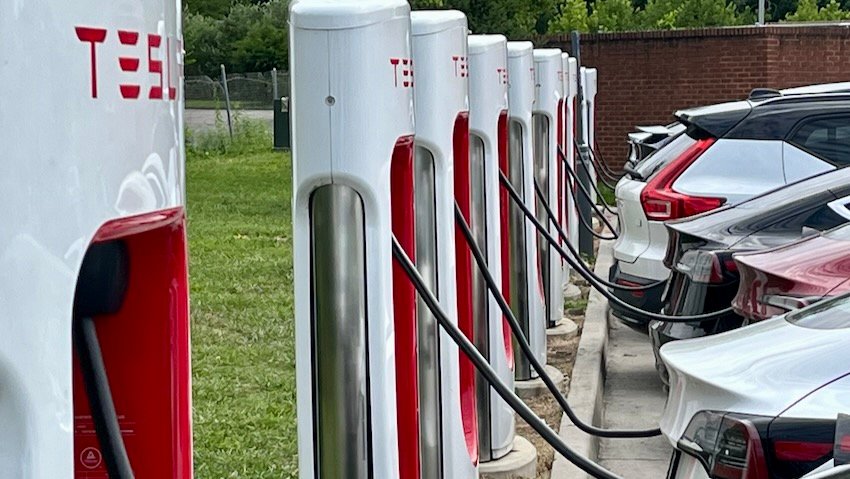
According to Tesla’s website, congestion fees apply when a Supercharger site is busy and a vehicle’s charge level is above 80% or charging is complete. Unlike traditional idling fees, which begin once charging stops, Tesla’s congestion fees have applied while the vehicle is still drawing power. Accruing time-based fees of any kind before the charging stops did not appear to comply with the new law.
I anticipated that one of three things would occur after the law took effect: Tesla would restructure the congestion fee at Maryland Supercharger locations to trigger only after the session ends, Tesla would stop assessing congestion fees at Maryland sites altogether, or Tesla would wait to see whether Maryland Weights and Measures treated it as an enforceable violation.
There is now evidence of a change to Tesla’s congestion fees that appears to apply only to Maryland, suggesting a direct response to the new law.
New Maryland-Specific Conditional Language
Note the congestion fee language on a Supercharger screen photographed at Jessup, MD on August 14, 2026: “When the site is busy and charge levels are above 100%…” Compare that to language captured at the same site on April 30, 2026: “When the site is busy and charge levels are above 80%…”

I checked the congestion fee language on the Tesla app at all 75 Supercharger sites in Maryland. Every one of them now states that per-minute congestion fees are incurred only when the site is busy and charge levels are above 100%, or once charging is complete. I checked at least two Supercharger sites in each of the other 49 states and DC and confirmed that Maryland is the only state where Tesla uniformly applies per-minute congestion fees after 100% rather than 80% charge level.
At 100% state of charge, a vehicle’s battery has reached its maximum capacity and active energy delivery has effectively ceased. This marks the conclusion of the active charging session. Setting the congestion fee trigger at that point seems to align with the new Maryland law: that time-based fees may be applied only at the conclusion of a charging session.
What this means for Maryland Supercharger Users
Congestion fees can still appear at busy Maryland Supercharger sites, but they will only begin when the vehicle is no longer actively charging. As before, Tesla may automatically adjust the charge limit down to 80% at busy Supercharger sites, which will typically trigger the congestion fee when charging stops at that level. In many cases, you can override the 80% limit and set it higher if desired.
Related
Discover more from Plug-In Sites
Subscribe to get the latest posts sent to your email.