Roadtrip Lessons
If you want to learn the truth in the world, you’ve got to get out in it. We’ve just returned from a 4,200 mile EV roadtrip through the south eastern United States where we stopped at 130 charging stations.
There is no greater touchstone for ground truth in America than a visit to a Waffle House. FEMA uses the number of their restaurants that are able to remain open – “The Waffle House Index” – as an unofficial metric to assess disaster severity.
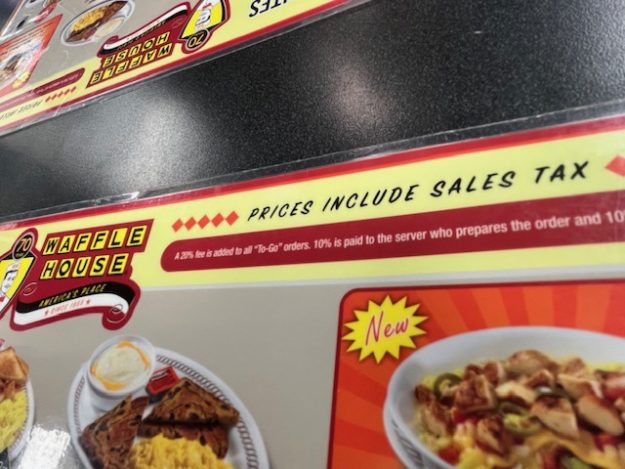
Gazing at the Waffle House menu for a late dinner while our car charged nearby, I noticed these words at the top, “prices include sales tax.” If Waffle House can do it, and gas stations do it, why can’t EV charging providers state their prices inclusive of all taxes? This inspired me to post a proposal for “the Waffle House Rule” on EV charging prices. Include the taxes in the advertised per kWh price.
The previous day, I had stopped at a fast charger that is owned and operated by Florida Power and Light. The Florida Public Service Commission had recently granted the utility a price increase from $0.32/kWh to $0.45/kWh at FPL owned fast chargers. When I charged at an FPL charger last week, my total bill for 10 kWh was not $4.50, but $5.80 after taxes and fees.

The advertised price of $0.45/kWh essentially became $0.58/kWh after the following taxes and fees:
Franchise Tax (6.3584%)
Gross Receipts Tax (2.6512%)
Local Option Surtax (1%)
Municipality Utility Tax (10%)
State Sales Tax (6.95%)
Compare this to the advertised price of gasoline which has taxes included. To make this even more confusing, the fast chargers at another utility-owned charging network in Florida, Duke Energy, advertise their rates as $0.32/kWh and that is with all taxes included.
Why can’t there be displayed price consistency even among chargers owned by regulated utilities in the same state? Maryland has the same issue. One regulated utility, SMECO, advertises their prices at their Level 2 and fast chargers as $0.18/kWh and $0.34/kWh respectively which includes the 6% state sales tax that is applied to electricity at EV charging stations. All the other Maryland utilities advertise their rates before taxes which for most are $0.17/kWh for L2 and $0.32/kWh for fast chargers. To further complicate prices, some utilities pass along a local “energy tax” to consumers at their chargers that are located in jurisdictions that have enacted these energy taxes. For example, Pepco-owned public charging stations in Montgomery County have an extra two cents per kWh billed to drivers on top of the base rate and sales tax. This effectively makes the all-in cost per kWh for Pepco charging stations in Montgomery County $0.20/kWh and $0.36/kWh.
Tesla advertises their rates with the tax included. For example, a 20 kWh session at a Supercharger that advertises the price as $0.50/kWh will show a pre-tax kWh cost of around $0.4717 and $0.0283 sales tax (6%) for each kWh on the receipt. This is consistent with the Waffle House practice of “prices include sales tax” as well as the taxes-included nature of the price of fuel at gas stations.
The pricing inconsistency I observed on the road also exists in Maryland, and it has a potential legislative remedy worth considering.
Florida prohibits time-based fees and session fees, Maryland should too.
A pair of bills in the Maryland General Assembly this session, SB 649 and HB 969, aim to address EV charging pricing by “requiring all electricity possessed, offered, or exposed for sale and sold at retail as a vehicle fuel to be measured and sold in units of kilowatt-hours.”
The problem is that the language in both bills would still allow charging operators to “charge a fee for services related to the retail sale of electricity as a vehicle fuel.” In effect, this is a loophole that still allows session fees and time-based fees as long as they are in addition to a per kWh fee. The irony is, this is interpreted by the Maryland Department of Agriculture Weights and Measures to apply even if the kWh fee is zero.
I believe that these bills were well-meaning attempts to deal with operators that are intent on gaming the rules by setting the price per kWh to $0.00 and applying a high per hour fee to be in technical compliance with Weights and Measures but not the intent. The original approach was to solve the loophole by eliminating the avenue for operators to set the price per kWh at zero by mandating a minimum price. The original language included, “requiring the Comptroller to determine the minimum price for the retail sale of electricity as a vehicle fuel…”
This would have created a new set of problems and the language was dropped. This essentially let the loophole remain and shifted the focus of the bills to codifying several specific provisions of NIST Handbooks 44 and 130 into Maryland law while staying silent on the remainder of the many aspects covered in those standards. I testified in opposition to HB 969 before both the House and Senate Committees.
One reason I believe the original intention of these bills were to address the loophole is that I had once questioned MDA Weights and Measures on their reasoning when they dismissed a complaint and explained that the $0.00/kWh display with a time-based fee was in technical compliance with the national standards. They suggested submitting a “Form 15” to the National Council on Weights and Measures to get the language changed, a process that would take years to resolve.
A $0.00/kWh fee along with an uncapped time-based fee is said to be in technical compliance, while essentially the same fee structure without the zero kWh display is not. The practical effect on the consumer is identical. The road trip that took me to a Waffle House brought this back into focus.
Last week it came to my attention that Florida has addressed this issue through Administrative Code Rule 5J-28.007 (effective May 1, 2025) by prohibiting all pricing methods other than per-kWh for public EV charging and by requiring that one unified price, inclusive of all taxes and fees, be displayed to the customer before the sale.
My experience with FPL chargers notwithstanding, this is just like the simple Waffle House menu prices and the price of gas displayed at gas stations.
On April 6, I emailed Maryland lawmakers asking for an amendment similar to the Florida provisions to be added to HB 969. While I remain opposed to the provisions of the current bill, I would not be opposed to language that would truly provide consumer protection and real price transparency to EV drivers since the legislature appears intent on moving forward with the bill.
Adapted to HB 969’s existing structure, the following amendment could be added as subsection (D) to Section 11-316:
(D)(1) METHODS OF SALE FOR ELECTRICITY AS A VEHICLE FUEL OTHER THAN SALES BASED ON THE COST PER KILOWATT-HOUR OF ELECTRICITY DELIVERED, OR BASED ON A SUBSCRIPTION CONTRACT THAT INCLUDES THE COST OF THE ELECTRICITY RECEIVED, ARE PROHIBITED.
(2) FEES ASSESSED FOR OTHER SERVICES IN DIRECT CONNECTION WITH THE FUELING OF A VEHICLE, OR ANY SIMILAR FEE IN ADDITION TO THE FEES CHARGED FOR THE KILOWATT-HOURS OF ELECTRICITY DELIVERED, EXCLUDING IDLE TIME FEES, ARE PROHIBITED. ALL COSTS TO THE CONSUMER, INCLUDING APPLICABLE TAXES, SHALL BE INCLUDED IN THE COST PER KILOWATT-HOUR OR THE TOTAL COST OF THE SUBSCRIPTION-BASED SERVICE.
(3) PARKING FEES FOR THE USE OF PUBLIC PARKING SPACES IN LOTS OR PARKING STRUCTURES ARE NOT CONSIDERED SERVICES DIRECTLY CONNECTED WITH THE FUELING OF A VEHICLE FOR THE PURPOSE OF SUBSECTION (D)(2) OF THIS SECTION.
(4) ELECTRIC VEHICLE CHARGING STATIONS USED SOLELY FOR FLEET FUELING PURPOSES ARE EXEMPT FROM THIS SUBSECTION.
If this amendment were adopted, Maryland EV drivers would finally see what every gas station customer already takes for granted: one honest price, before they commit to a purchase.
Related
Discover more from Plug-In Sites
Subscribe to get the latest posts sent to your email.