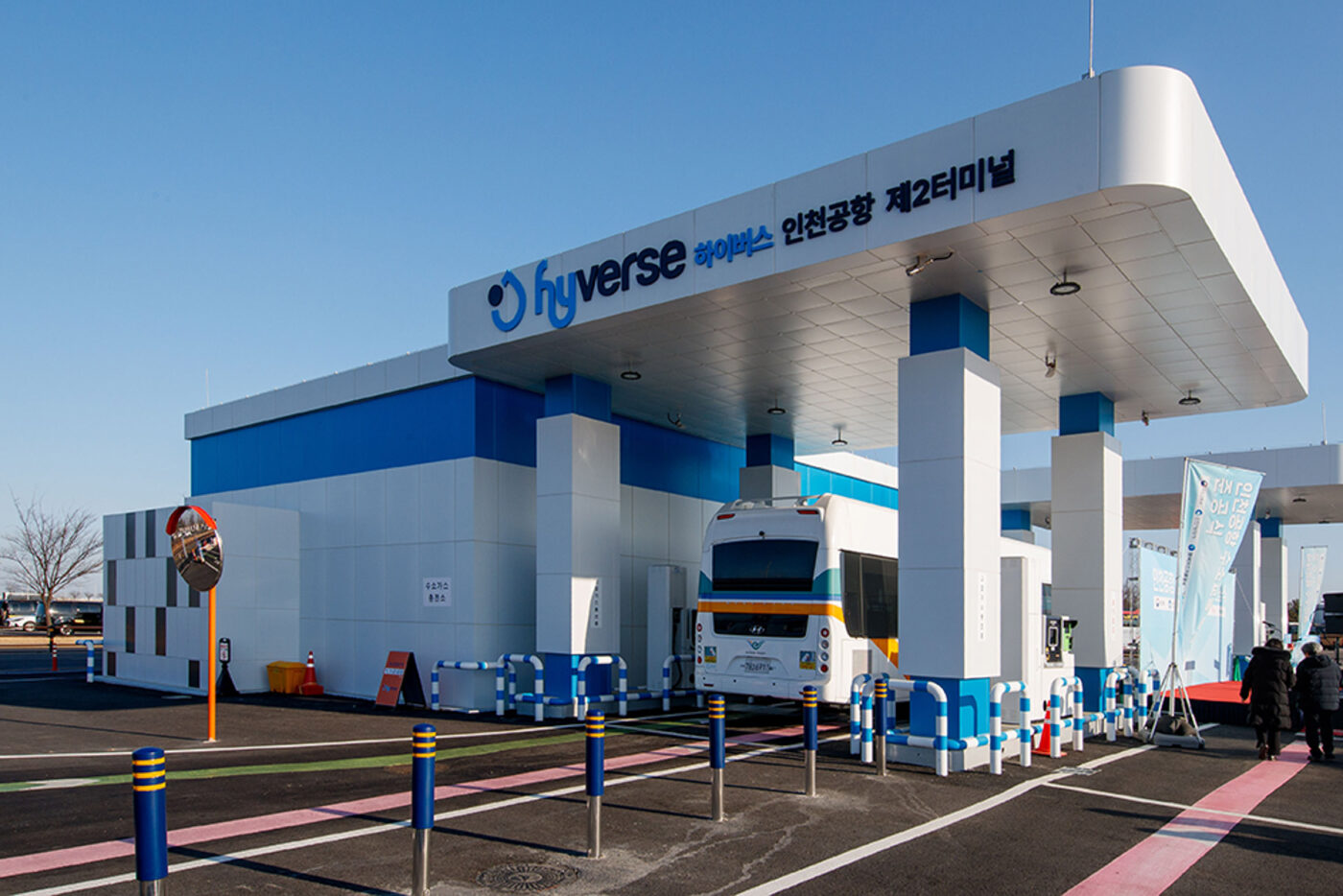
South Korea’s Incheon has opened a hydrogen mobility hub at Incheon International Airport, marking a significant step in the city’s long-running push to deploy hydrogen in transport and reduce emissions from high-mileage commercial vehicles.
The hub, located in the Terminal 2 car park, includes a liquid hydrogen refuelling station designed to support the transition of airport shuttle buses and other commercial vehicles to hydrogen. The facility covers about 2,771 square metres and can dispense up to 320 kilograms of hydrogen per hour, enough to refuel as many as 240 large hydrogen buses per day, according to project partners.
See also: Hyundai Motor Group and Pyeongtaek City Partner to Develop Korea’s First Green Hydrogen Port
Although the airport lies on an island off the coast of Incheon rather than in Seoul itself, it serves as the main international gateway for the capital region. The hydrogen buses do not operate airside but run long-distance shuttle services connecting the airport with surrounding cities. Each bus covers an average of about 548 kilometres per day, a duty cycle that operators say favours hydrogen fuel cells over battery-electric technology. One hydrogen bus is estimated to cut greenhouse gas emissions by around 56 tonnes annually.
Of the airport’s 68 shuttle buses, 36 are already hydrogen-powered, with additional deployments planned this year. Smaller shuttle buses serving Seoul and Gyeonggi Province are also set to transition to hydrogen using the new hub. Incheon in 2023 ordered 700 fuel cell buses from Hyundai, part of a broader strategy to scale hydrogen mobility across the region.
See also: South Korea Opens Nation’s Largest Hydrogen Refuelling Station for Commercial Vehicles in Ulsan
The refuelling infrastructure uses subcooled liquid hydrogen, or sLH2, which is stored at about -253 degrees Celsius. Liquid hydrogen has a higher energy density than compressed gaseous hydrogen, allowing vehicles to carry more fuel or achieve longer ranges with the same tank size. However, the technology requires continuous cooling and is best suited to vehicles with high daily utilisation, such as airport shuttles and long-haul trucks.
The project involved total investment of about 14.3 billion won ($8.3 million), including 7 billion won from the Korean Ministry of Land, Infrastructure and Transport, 3 billion won from the city of Incheon and 4.3 billion won from Hyverse. Hyverse is a subsidiary of SK Innovation E&S and operates 21 liquid hydrogen refuelling stations nationwide.
Officials said the airport hub is intended as a model for deploying hydrogen infrastructure where vehicles log long daily distances and rapid refuelling is essential, supporting South Korea’s broader goals for cleaner transport and industrial decarbonisation.