Five Year DC Fast Charger Usage Trends
Since 2020, I have been closely monitoring the usage patterns of electric vehicle fast chargers near my home in Columbia, Maryland. This study includes a mix of CCS, CHAdeMO, and Supercharger stations operated by EVgo, Electrify America, Tesla, a High’s convenience store and the local electric company, BGE. My approach is simple: I track electricity consumption at each location by recording the meter readings each month. The goal of this project is to gain insights into how fast charging infrastructure is being utilized in our region and to identify real world trends in usage growth.
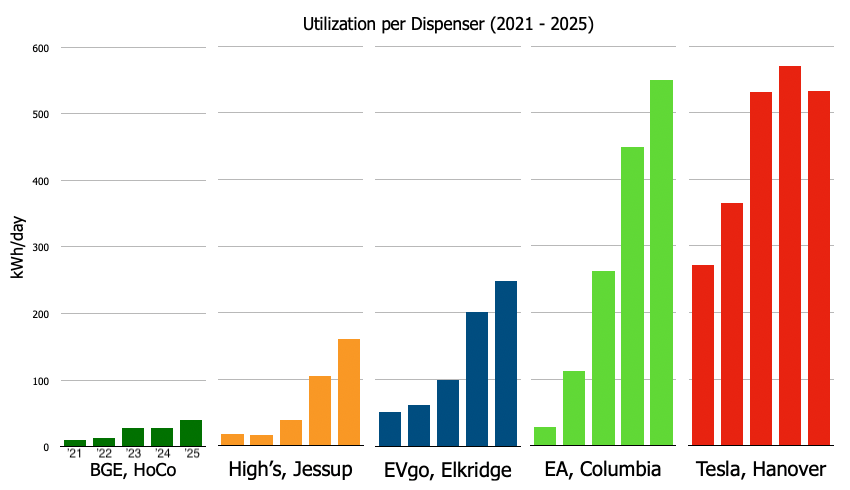
The graph above visualizes year-by-year utilization growth at the five different fast charging sites between 2021 and 2025. Previous posts have reported the average daily kWh per stall dispensed on a quarterly basis over periods of a single year or 18 months. I calculate the average daily throughput per site by taking the total kWh of electricity in the period of time and divide it by the number of days in the period. Then the average daily site usage figure is divided by the number of charging ports at the site to normalize the metric to allow comparison.
Map of Locations

BGE, Howard County

The first site is a BGE owned charging station behind the Howard County office building on Stanford Blvd that was commissioned in June 2020. It has six Level 2 charging ports in addition to two 50 kW Efacec fast chargers. Because the electricity meter covers all eight units, the reported kWh for the fast chargers includes all Level 2 usage. Even with that inclusion, this site has the lowest utilization by far, averaging just 41 kWh per port daily in 2025.
High’s, Jessup

The High’s store in Jessup has a pair of 50 kW ChargePoint fast chargers that have seen steadily increasing utilization. The average daily utilization per port for 2025 reached 160 kWh.
EVgo, Elkridge

Located just 1.4 miles from I-95 Exit 41, the Gateway Overlook EVgo station opened in late 2014 and is the oldest site among the five studied. The equipment was upgraded several years ago. These 50 kW chargers had an average daily usage of 247 kWh each in 2025, a significant increase from the 51 kWh recorded in 2021.
Electrify America, Walmart

The 10 stall Electrify America station at the Columbia Walmart has been operating since November 2019. Two stalls are capable of delivering 350 kW, while the remaining eight offer up to 150 kW. This site is a six minute drive from I-95. As the light green bars in the graph illustrate, electricity consumption here has increased steadily each year. While early growth might be attributed to OEM partner complimentary charging for new EV owners, most of those deals have now expired. Despite this, the 2025 average daily utilization was 549 kWh per port.
Tesla, Hanover

The Hanover Supercharger, located in the parking garage at the Hotel at Arundel Preserve, opened in November 2019. It has eight stalls delivering up to 72 kW each. As shown by the red bars, this site consistently had the highest utilization until 2025, when the average daily kWh per stall dipped slightly from 571 in 2024 to 533.
This leveling off suggests that the Hanover Supercharger may have reached its maximum daily throughput. Drivers have frequently had to wait during peak periods because all eight stalls were occupied. This slight decrease in 2025 may also be explained by the opening of a new Tesla Supercharger nearby in Arbutus. That site offers faster charging, up to 325 kW, and has twice as many stalls as the Hanover location.
Conclusion
The data collected over the past few years paints a clear picture: demand for fast chargers is rising, but it remains unevenly distributed. The stagnation of the BGE station throughput stands in stark contrast to the sharp growth of the Electrify America station less than a mile away.
This ongoing analysis has been surprising at times, as expected trends do not always materialize. It is useful to track actual progress to compare against past predictions and industry forecasts. By doing so, policymakers can make informed decisions based on real data. I hope this work helps establish a more robust and reliable EV charging network for Maryland drivers.
Related
Discover more from Plug-In Sites
Subscribe to get the latest posts sent to your email.