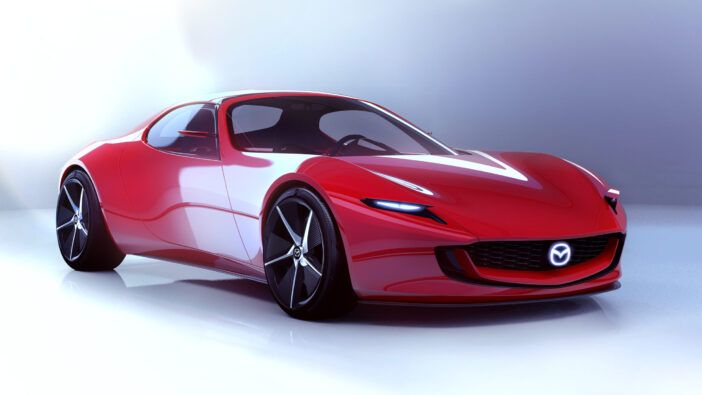
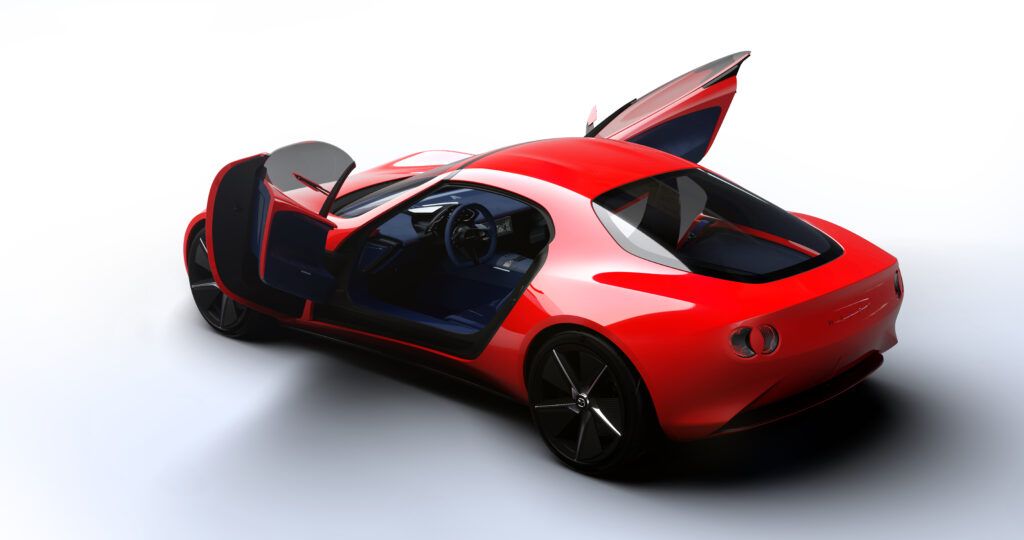
When Mazda revealed the Iconic SP a couple of years back, the general consensus was that it was too good to remain just a concept. Thankfully the Japanese company were listening…
Concept cars are typically used to signpost a brand’s future and rarely appear as production versions that stay true to the original design. Oftentimes this either due to regulatory requirements or ambitious designs that were never really intended for production. When Mazda unveiled its Iconic SP concept at the 2023 Japan Mobility Show, it was just a concept, a hint, maybe, of the Japanese manufacturer’s intentions for the future.
A year on from its debut though, Masashi Nakayama, General Manager at Mazda’s Design Division has revealed the opposite: “This concept is not just one of those empty show cars,” he said, “It’s been designed with real intent to turn it into a production model in the not-so-distant future.”
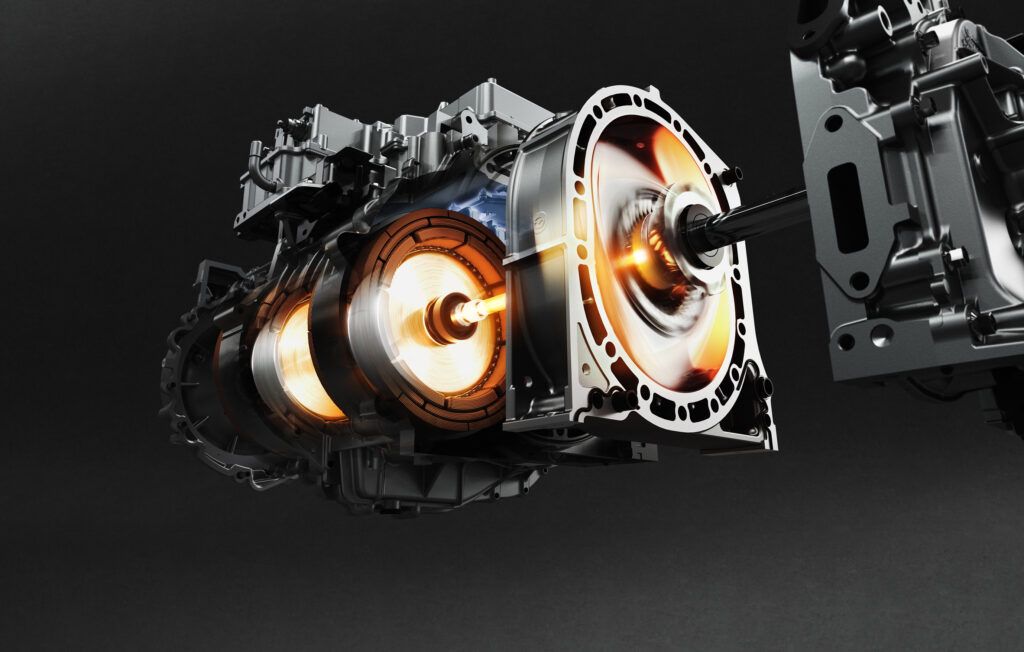
Unlike most concepts that focus on exterior and interior design first and foremost, the Iconic SP was crafted around its dual-rotor rotary engine EV powertrain. “Standing by the car, you should be able to picture what sort of engine would be housed under the bonnet,” said Naohito Saga, Executive Officer at Mazda’s R&D Strategy Planning Division. “That’s how committed we were to crafting this concept car. In the development process, everything from the position of the doors and tires to the length of the vehicle, the seating position of the occupants and visibility was meticulously researched before reaching the final specifications. It really shows how much we wanted to make it a car that manifests Mazda’s commitment for the future, especially in terms of sustainability and the future role of our rotary engine technology.”
Circling the square
Underlining its commitment to this kind of engine and alternative hybrid technology, Mazda reinstated its rotary engine development group as part of its powertrain technology development department at the start of 2024. “For the last six years, rotary engine engineers have been part of the engine development organization where they engaged in the development of state-of-the-art internal combustion engine functions as well as the ultimate improvement in efficiency,” said Ichiro Hirose, Director, Senior Managing Executive Officer, and Chief Technology Officer. “Those engineers have broadened their perspective beyond the boundaries of engine systems and have trained themselves to master model-based development, which is one of Mazda’s engineering strengths. This time, 36 engineers will gather in one group to make a breakthrough in the research and development of rotary engines.”
Although Mazda’s last rotary-engined model, the RX-8, was discontinued in 2012, the technology was reintroduced in a new way in 2023. The Mazda MX-30 R-EV tackles some of the key issues with rotary engines by using the engine as an on-board generator. Employing the same concept, the Iconic SP uses a dual-rotor system instead of a single-rotor configuration like the series plug-in hybrid MX-30 R-EV. This is designed to increase power output to 365bhp.
“The rotary engine can be very compact and very powerful at the same time,” said Saga. “That’s one advantage, but also it can be powered by various types of fuels, and that could give us an edge in the race to find a feasible solution for the future of mobility.” This combination of characteristics makes it an ideal powertrain to use in a futuristic lightweight sports car.
While the Iconic SP will incorporate an electrified powertrain, Mazda hopes to maximize its sustainability credentials by using carbon neutral fuels such as e-fuels, biofuels and hydrogen. In an ideal scenario, any additional power needed to recharge the battery would also be from a sustainable source to facilitate carbon neutral driving using a combustion engine as a generator. Efficiency and emissions compliance contributed to the downfall of the RX-8, so repositioning the rotary engine as a generator could help to provide greater control over the engine’s output.
Carbon capture
Considering the challenges on the way to its carbon neutral rotary engine hybrid powertrain goal, Mazda said, “A prerequisite for engines to be utilized in the age of electrification is their emission compliance, and the rotary engine has the highest hurdle compared to other engines. Mazda will continue to take on the challenge of developing for emission compliance of rotary engines, believing that it can contribute to Japanese manufacturing by opening the lessons learned from this challenge as technologies to be applied not only to Mazda engines, but also to engines from other companies.”
While Mazda is yet to release full details on how it expects to package the Iconic SP’s dual-rotor rotary engine generator and EV powertrain, the compact nature of the engine and accompanying electric components is expected to allow for a more flexible layout. Once a suitable battery size is determined, the team will decide where to install the battery. Since the Iconic SP model does not have a drive shaft, there is a greater range of options available to mount the batteries. Mazda also anticipates technological progress will support optimal battery layout and integration.
“We will continue to offer customers exciting cars by honing internal combustion engines for the electrification era and expanding the multi-pathway possibilities for achieving carbon neutrality,” said Masahiro Moro, Representative Director, President and CEO of Mazda Motor Corporation. “Given the rotary engine’s compatibility with electrification and carbon-neutral fuels, Mazda will continue to develop the technology through co-creation and competition to ensure it can contribute broadly to society.”
All this ties in with Mazda’s aim to achieve its target of “the more you drive, the cleaner the air”. As well as implementing carbon neutral fuels, the company wants to capture CO2 emitted in the combustion process. Mazda is targeting CO2 reduction by 90% using carbon neutral fuels and hoping to capture 20% of CO2 emitted to achieve 10% CO2 negative emissions. “Mazda is trying to capture CO2 from the exhaust gas,” said a company statement. “Since the concentration of CO2 in exhaust gas is higher than that in air, it is possible to capture CO2 efficiently. On the other hand, the difficulty of the technology required increases, such as lowering the gas temperature to a temperature that is easier to capture. We are currently working on basic functional tests based on the model-based approach to establish the technology.”
BEV supply chain in Japan
While Mazda plans ahead for the future of rotary engines, the company is also securing supply chains to support a wider roll out of EVs. Panasonic Energy is set to supply Mazda with cylindrical lithium ion batteries from 2027 which Mazda will module-package in-house. To meet demand once Mazda launches its first model on a dedicated EV platform, Panasonic Energy plans to increase capacity at its Suminoe and Kaizuka factories in Osaka, Japan.
Kazuo Tadanobu, President and CEO of Panasonic Energy said, “Through this collaboration, we are poised to drive the expansion of BEV manufacturing and boost the competitiveness of Japan’s battery industry. Our ultimate goal is to foster a sustainable society, and we are dedicated to achieving this mission.”
By 2030, Panasonic Energy is aiming to reach Japanese production capacity of 10GWh annually working with Mazda. The project is designed to create a stable battery supply chain in Japan and increase the country’s manufacturing presence in this industry.
Masahiro Moro, President and CEO of Mazda, said, “Mazda is committed to achieving carbon neutrality and is driving the transition to electrification through a range of solutions that cater to our customers’ needs and lifestyles. We will make the most of the highly efficient, high performance, and safe batteries supplied by Panasonic Energy, and deliver distinctive Mazda BEVs to our customers that perfectly balance design, convenience, and driving range.”
Fastback hatchback
At the beginning of the year Mazda unveiled its latest EV, the Mazda6e, at the Brussels Motor Show, signaling a significant transformation of its popular mid-sized sedan for the European market.
The new EV offers two battery configurations: the smaller 68.8kWh version provides a range of up to 300 miles and can charge from 10 to 80 percent in just 22 minutes, adding 145 miles of range in a quarter-hour. Its electric motor delivers 258 horsepower, enabling a 0-62 mph acceleration in 7.6 seconds. While the larger 80kWh battery extends the range to 345 miles, with slightly reduced performance, reaching 62 mph in 7.8 seconds. Both versions feature a rear-wheel drive layout and produce 320 Newton-meters of torque.
Designed under Mazda’s ‘Kodo Soul of Motion’ philosophy, the vehicle showcases a sleek exterior with smooth flowing lines and bold features. Distinctive design elements include frameless doors, integrated door handles, and a unique front lighting signature that dynamically illuminates during charging.
“The Mazda6e is the car our dealers have been waiting for,” said Jeremy Thomson, Managing Director of Mazda Motors UK. “It’s a real statement of intent for the future and illustrates how Mazda can bring great design, technology, and style to battery electric vehicles.”
The interior emphasizes sophistication and spaciousness, inspired by the Japanese concept of ‘Ma’, which translates as a gap, space or pause. Indeed, you might want to take a moment to appreciate the panoramic roof, which floods the cabin with natural light, as well as the cockpit features a 14.6-inch touchscreen, 10.2-inch instrument set, and an augmented reality head-up display.
Thomson also highlighted Mazda’s approach to electrification. “In the UK, we are facing unique challenges in balancing EV legislation and consumer demand. We will introduce new models that fit the pace of actual consumer demand, offering a multi-solution approach including mild-hybrid, plug-in hybrid, and battery electric technologies.”
With its 330-litre boot, 70-litre front storage, and carefully calibrated suspension by Mazda Research Europe in Frankfurt, the Mazda6e represents the brand’s commitment to delivering an engaging electric driving experience tailored to European preferences.
The all-electric hatchback with a fastback saloon design is set to arrive in left-hand drive European markets this year, while UK customers will have to wait until the first half of 2026.