Good morning, good afternoon, and good evening wherever you are in the world, welcome to EV News Daily, your trusted source of EV information. It’s Saturday 22 March, I’m Martyn Lee and I go through every EV story so you don’t have to.
Patreon supporters get the episodes ad free. Be like them by clicking here: https://www.patreon.com/EVNewsDaily
TESLA ENHANCES GERMAN SUPERCHARGER NETWORK
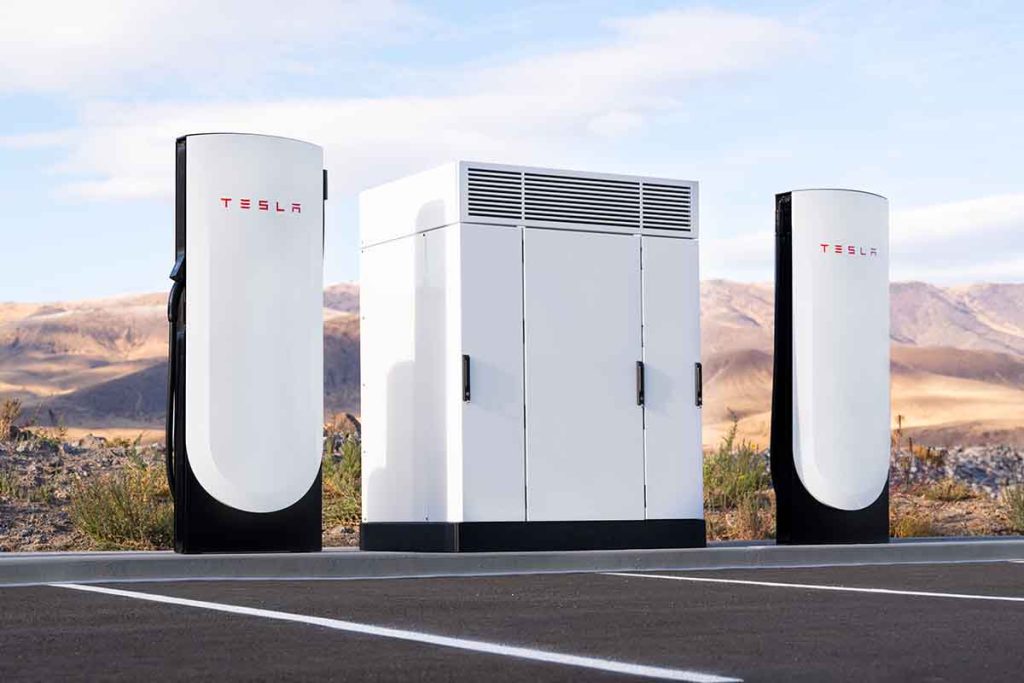
Since starting its Supercharger network in 2012, Tesla has grown to over 60,000 Superchargers worldwide, launching in Germany in 2014. The network now includes four generations of Superchargers. Older models with slower charging speeds have been replaced by the advanced V3 and V4 chargers. In Germany, all 250 Supercharger locations now support up to 250 kW charging capacity.
Recently, Tesla upgraded 69 locations in Germany from V2 to V4 technology, affecting a total of 640 charging points. The V2 Superchargers offered a maximum of 150 kW, while both V3 and V4 can deliver up to 250 kW. The V4 generation features a longer charging cable and an integrated display for compatibility with electric vehicles from other brands. In contrast, the V2 and V3 chargers were designed only for Tesla vehicles, with ports at the rear left that required shorter cables.
Since opening its network to non-Tesla vehicles in 2021, Tesla noticed that other brands often have charging ports in different locations. This caused parking space issues due to the short cables of V2 and V3 chargers. The new V4 Superchargers introduced in March 2023 solve this problem by offering greater flexibility for all electric vehicle owners.
Additionally, Tesla revealed new control cabinets for its V4 Superchargers in November. These cabinets can support peak charging rates of up to 500 kW, improving the efficiency and capacity of the Supercharger network.
https://evne.ws/4bMjRwf
BYD LAUNCHES ATTO 2 IN GERMANY, EXPANDS EU OFFERINGS
The BYD Atto 2, a 4.31-meter compact SUV, has launched in Germany and is now available for online configuration. This configurator was activated in other EU countries in late February.
The Active equipment line is priced at €31,990, while the Boost line costs €34,990. The previously announced promotional prices of €29,990 or €32,990 are no longer available online. The Comfort variant will launch in autumn and promises a higher range and faster DC charging.
Currently, the Atto 2 is BYD’s most affordable model in Europe but may soon change as BYD plans to focus on small electric cars. They are considering launching the Seagull from China and the Dolphin Mini from Mexico in Europe this year as the Dolphin Surf. Pricing is expected to be between the Dacia Spring and models like the Fiat Grande Panda or Citroën ë-C3.
In Germany, the Dacia Spring starts at €16,900, the Citroën ë-C3 at €23,300, and the Fiat Grande Panda just below €25,000. The expected starting price for the Dolphin Surf is around €20,000.
The larger BYD Dolphin with a 60 kWh battery costs about €16,000 in China and around €32,990 in Germany. The Seagull starts at roughly €9,000 in Germany. If priced similarly to these models, the Dolphin Surf would range between €18,000 and €20,000.
Stella Li, BYD’s vice president for Europe, told Autocar that the Dolphin Surf “will not be the cheapest model on the market but will offer the best value for money.” BYD’s management has highlighted the price-performance ratio for the Atto 2.
https://evne.ws/4iKYE8b
EU PROBES BYD FOR EV SUBSIDY BREACHES
China’s top automaker, BYD, is under investigation by the European Union for allegedly breaking its electric vehicle subsidy rules.
The Financial Times reports that BYD received improper subsidies from the Chinese government for its electric vehicle plant in Hungary. This led the EU Commission to impose extra tariffs on electric vehicles exported from China to Europe.
The European Commission has started a preliminary investigation into BYD’s plant in Hungary. If they find evidence of Chinese subsidies, BYD may have to sell some assets, cut production, repay the subsidies, and face penalties.
In October 2024, many EU member states voted for additional tariffs on Chinese-made electric vehicles. The EU imposed a 17.0% levy on BYD, along with a standard 10% car import duty. Geely faced an 18.8% additional duty, while SAIC had a tariff of 35.3%.
Most car manufacturers exporting from China to Europe face a 35.3% duty. However, some companies like Tesla and BYD have specific rates. Tesla asked the EU Commission to review its Shanghai operations for a different tariff rate and was assigned a rate of 7.8%.
https://evne.ws/4c5WtKp
HONDA AND ACURA EVS TO USE TESLA SUPERCHARGERS
Starting in June 2025, owners of the Honda Prologue and Acura ZDX electric vehicles will be able to use over 20,000 selected Tesla Supercharger stations in the United States. This is a more specific timeline than earlier estimates. Honda will also sell a “Honda-approved NACS-CCS DC fast-charging adapter” at dealerships around that time.
Ryan Harty, assistant vice president of Sustainability & Business Development at American Honda Motor, said, “Adding Tesla Supercharger network access to the charging networks already available to our EV customers means industry-leading fast-charging access for Honda and Acura EV drivers. By the end of this decade, we strive to provide Honda and Acura EV drivers with the most convenient and easy charging at more than 100,000 charge points nationwide, helping people choose to purchase an EV for the many benefits of driving one.”
Tesla’s Supercharger network is known as the most reliable and extensive fast-charging network in North America. Tesla opened its network to other automakers after the Biden administration announced funding for charging stations accessible to multiple electric vehicle manufacturers. Other automakers with Supercharger access include BMW, Genesis, Hyundai, JLR, and Kia. Honda and Acura are now added to this list.
https://evne.ws/4kLKxkO
VOLKSWAGEN LEADS EUROPEAN EV SALES SURGE IN FEBRUARY
Volkswagen boosted sales of its ID3, ID4, and ID Buzz electric models, while Ford saw gains from the battery-powered Explorer. In February, combined sales in Europe’s five largest markets fell by 2.3% to 661,332 units, with four out of five markets seeing year-on-year drops.
Dataforce reported that 38 automakers had lower sales compared to February 2023. However, another 38 brands, including BYD and MG, saw increases. Tesla’s sales dropped 44% to 15,255 units as all its models fell by at least 11%. In contrast, Volkswagen’s electric vehicle sales rose by 182% to 19,519 units, with all ID models increasing by at least 25%.
February also welcomed three new top-selling electric vehicles. The Renault 5 was the fourth best-selling battery-electric car with 5,538 units sold. The Kia EV3 ranked seventh with 5,347 sales, followed by the Citroen e-C3 in eighth place with 5,094 units.
Overall, Europe’s electric vehicle sales grew by 26% to 160,992 units in February. Chinese car sales increased by 64% to 38,902 units for the second month in a row. Polestar saw an 83% rise in sales to 2,393 units due to the full-electric Polestar 4 making up 52% of its total volume. Cupra recorded a 31% increase in sales to 20,389 units thanks to strong demand for the fully electric Born hatchback with sales of 3,386 units.
https://evne.ws/4iQrap3
CANADA’S EVS ACHIEVE SIGNIFICANT EMISSIONS REDUCTIONS
Electric vehicles (EVs) in Canada produce about one-quarter of the life cycle emissions of internal combustion engine vehicles (ICEVs), according to a TD Economics study. This includes comparisons even on the most carbon-intensive electricity grids.
The analysis, published on March 4, shows that the average battery-electric vehicle in Canada has emissions reductions of 70% to 77% compared to ICEVs, depending on the vehicle type. This covers all stages of a vehicle’s life, including raw material extraction, manufacturing, fuel production and use, maintenance, and disposal. The study assumes an annual driving distance of 15,000 kilometers and an 18-year vehicle lifespan.
EVs consistently lower life cycle emissions across Canada. The savings depend on how clean the provincial power grid is. In Quebec and Manitoba, where nearly all electricity comes from hydroelectric sources, electric SUVs achieve about 83% emissions savings. Ontario’s mix of nuclear, hydro, and renewable energy leads to around 80% reductions.
Provinces that rely on coal or natural gas see smaller savings. In Alberta, electric SUVs save about 55% compared to gasoline models; in Saskatchewan, it’s around 45%. Nunavut has the lowest savings at 25%, as it uses diesel generators for all its electricity.
While EVs have lower overall life cycle emissions, the TD report notes that initial emissions from resource extraction and manufacturing for 2024 EV models are roughly twice those of ICEVs due to battery production requiring significant metals and energy. However, switching from gasoline or diesel allows EVs to outperform ICEVs in emissions after just two years of ownership.
Electric motors in EVs use energy more efficiently by converting 87% to 91% of battery energy into movement through regenerative braking. In contrast, ICEVs only convert 16% to 25% of gasoline energy for propulsion due to losses in engines and drivetrains.
The report also mentioned that improving power grids in fossil fuel-heavy provinces would further boost the emissions benefits of EVs.
https://evne.ws/4kK16xx
BATTERY HEALTH CERTIFICATES BOOST USED EV CONFIDENCE
A recent study by Stack Data Strategy for Axa UK shows that 63% of UK drivers do not plan to buy an electric vehicle (EV). Among them, 37% worry about the long-term health of EV batteries. Additionally, 61% think EVs are too expensive, and 36% mention a lack of local charging stations as a reason not to buy.
The research reveals a knowledge gap about the used EV market, with 64% of respondents feeling there is not enough information on buying used electric vehicles. To tackle this, Axa UK released a report titled “Sparking Change – the case for delivering EV battery health certificates.” The report calls for standardized battery health information for all EV models to boost consumer trust in used EVs.
Currently, new EVs in the UK come with warranties covering eight years or 100,000 miles for both the vehicle and its battery. However, these warranties usually do not transfer to new owners, and there is no system to monitor battery health in second-hand EVs. Axa suggests that introducing battery health certificates could help insurers better assess the value of used EVs, similar to how mileage is evaluated in traditional vehicles.
Labour’s pre-election manifesto includes a proposal for standardized battery health checks. Axa urges the government to adopt this measure quickly to support the growth of the used EV market and build consumer confidence.
https://evne.ws/4irD491
UK INTEREST IN TESLA EVS DECLINES SHARPLY
Recent data from Leasing Options shows that interest in Tesla electric vehicles is dropping among UK drivers. In the past year, leasing inquiries for Tesla have fallen by 11 percent. More strikingly, from February 2024 to February 2025, leasing demand for the brand has dropped by 87 percent.
Mike Thompson, COO of Leasing Options, said, “Tesla has always been as much about brand image as it has been about technology. However, growing controversy around Elon Musk – both in his leadership of Tesla and his wider public persona – is alienating consumers. His outspoken political views and controversial social media activity have led some former fans to distance themselves from the brand. People are re-evaluating their options and right now, Tesla isn’t the automatic first choice it once was.”
This decline follows a survey showing that 70 percent of Tesla owners feel ‘ashamed’ of their vehicle. The drop in interest isn’t due to a general disinterest in electric vehicles; Leasing Options reports a 509 percent increase in electric car leasing inquiries over the past year. Inquiries for the Chinese brand BYD have surged by 793 percent, while Ford’s EV leasing interest rose by 156 percent. Volkswagen’s electric models also saw a 127 percent increase.
Thompson added, “Tesla, once the undisputed leader in the EV space, is now facing serious pressure from competitors who are matching or even surpassing them on price, range, and features.”
https://evne.ws/41HNqdE
TESLA FACES $1.4B ACCOUNTING DISCREPANCY
A recent Financial Times report reveals a $1.4 billion discrepancy in Tesla’s asset accounts. It shows that in the latter half of 2024, Tesla reported $6.3 billion spent on property and equipment purchases, excluding finance leases and net of sales. However, the increase in property, plant, and equipment (PP&E) during this time was only $4.9 billion.
Accounting experts note that capital expenditure figures usually match the rise in gross PP&E. Variations can occur due to asset sales, impairments, or foreign exchange changes, but Tesla did not report any significant shifts in these areas to explain the $1.4 billion gap.
The report also raises concerns about Tesla declaring $37 billion in cash while raising $6 billion in new debt last year. While it’s common for companies with large cash reserves to increase debt, this is seen as less favorable now.
Additionally, Tesla did not start share buybacks or declare dividends despite having a $15 billion operating cash flow last year, which exceeds its capital expenditures. This is unusual for large corporations and places Tesla alongside companies like Temu.
In 2022, CEO Elon Musk expressed plans to use some of the company’s cash for share buybacks, but this has not happened.
Jacek Welc, a professor of corporate finance at SRH Berlin University of Applied Sciences, compared these financial issues to scandals involving Wirecard and NMC Health.
https://evne.ws/4bNRFsS
PREMIUM PARTNERS
PORSCHE OF THE VILLAGE CINCINNATI
AUDI CINCINNATI EAST
VOLVO CARS CINCINNATI EAST
NATIONAL CAR CHARGING ON THE US MAINLAND AND ALOHA CHARGE IN HAWAII
OCTOPUS ELECTROVERSE GLOBAL PUBLIC CHARGING MADE SIMPLE WITH ONE APP AND ONE MAP
PARTNERS
RICHARD AT RSEV.CO.UK
JUKKA KUKKONEN FROM WWW.SHIFT2ELECTRIC.COM
RAJEEV NARAYAN
BATTERY REPORTS FOR EVS AT RECURRENTAUTO.COM
JAN TORE GJØBY
BOB BOOTHBY
EXECUTIVE PRODUCERS
ADRIAN BOND
ALAN SHEDD
ALEX BANAHENE
ANDERS HOVE
ANDREA JEFFERSON
ANDREW LUOMA
ANDREW WANEK
ANDY NANCARROW AND LILIAN KASS
ASEER KHALID
BÅRD FJUKSTAD
BILL CALHOUN
BLAINE MCKINNEY
BLUNDERBUSS JONES
BRANDON DIEDERICH
BRENDAN MCCARTHY AT NORTHFORK IRONWORKS
BRIAN OLEARY
BRIAN THOMPSON
BRUCE BOHANNAN
CHAD LANE
CHARLES HALL
CHRISTOPHER BARTH
C.J. BACKUS
COLIN HENNESSY AND CAMBSEV
CRAIG ROGERS
DAVE QUADY
DAVID DYSART
DAVID FINCH
DAVID LARDER
DAVID MOORE
DAVID PARTINGTON
DAVID PRESCOTT
DC EV
ED CORTEEN
ED SUTTON
EDDIE RAGASA
ERIC HANSEN
ERU KYEYUNE-NYOMBI
FREDRIK ROVIK
GARY A HAMMOND
GARY KNIBB
GENE RUBIN
GEORGE TORTAROLO
HEINRICH LIESNER
HELMUT SELKER
IAN
IAN ‘STILL WATERS UK’ BENJAMIN
IAN GRIFFITHS
IAN SEAR
JACK OAKLEY
JAMES PENFOLD
JAMES STORR
JAMIE HIGGS
JIM MORAN
JIM MORRIS
JOHN BERTRAM
JOHN SCHROEDER
JOHN VAN DEVOORT
JON AKA BEARDY MCBEARDFACE FROM KENT EVS
JON MANCHAK
JUAN GONZALEZ
KESTER SANDBACH
KEVIN MEYERSON
LAURENCE D ALLEN
LEE BROWN
LUKE CULLEY
MARCEL WARD
MARK RICHARDS
MATTHEW LONG
NATHAN GORE-BROWN
NATHAN KING
NATHANIEL FREEDMAN
NEIL E ROBERTS FROM SUSSEX EVS
OHAD ASTON
PAUL COLLINS
PAUL STEPHENSON
PETE GLASS
PETE GORTON
PETER & DEE ROBERTS
PETER RYNER
PHIL MILES
PHIL MOUCHET
PHILIP FORRESTER
PHILIP TRAUTMAN
RAYMOND ROWLEDGE
REALTORS CHOICE PHOTOGRAPHY
ROB FROM THE RSTHINKS EV CHANNEL ON YOUTUBE
ROBERT GRACE
RON HUNTER
ROOSEVELT WATSON
SEIKI PAYNE
STEPHEN PENN
STEVE JOHN
STEVEN BURTNESS
THE PLUGSEEKER’S EV YOUTUBE CHANNEL
THOMAS J. THIAS
TIMOTHY PHILLIPS
TOMER SHAHAF
TYLER VOSS